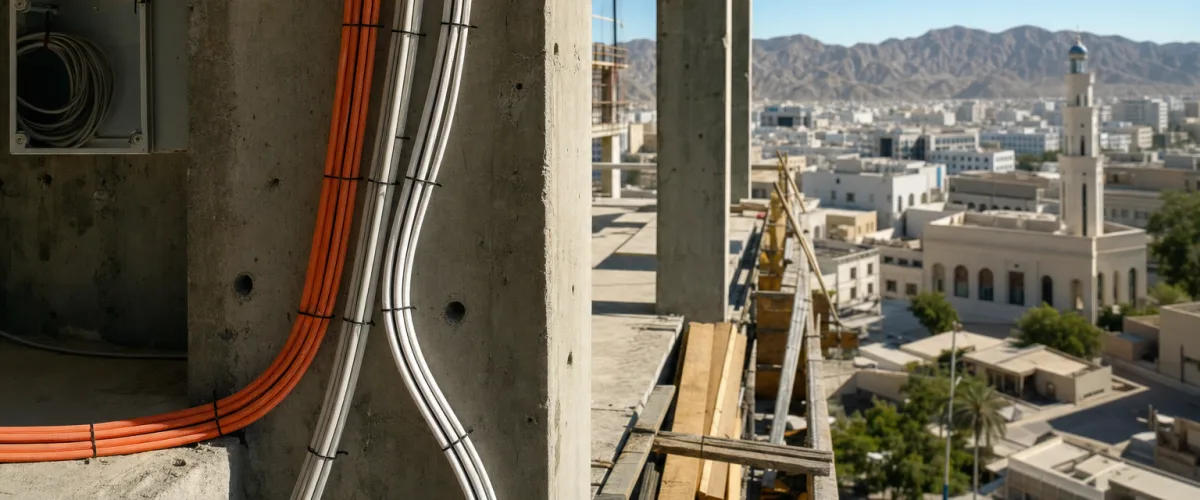
Oman's Telecommunications Regulatory Authority (TRA) issued Decision 1152/2/36/2026-12 on August 25, 2026, publishing the Regulation on Implementing Passive Telecommunications Infrastructure in Buildings and Real Estate Complexes in Official Gazette issue 1663 on August 30, 2026. The regulation obliges property developers, building owners and telecom licensees to build, certify and maintain standardised passive cabling and in-building coverage in new and substantially renovated buildings, backed by administrative fines of 500 to 800 OMR per building or unit.
Signed by Said bin Hamoud bin Said Al-Maawali, Minister of Transport, Communications and Information Technology and Chairman of the TRA Board, the regulation fleshes out the Executive Regulations of the Telecommunications Law (Royal Decree 30/2002). The full Arabic text sits with the decision notice on the Official Gazette's digital republication.
Which buildings must comply, and from when?
The rules bind new commercial, industrial and residential buildings and real estate complexes, plus any building renovated by more than 40% of its area, as the relevant municipality assesses it, or with a new floor added. Buildings and complexes that received construction permits before the regulation takes effect are exempt.
Most provisions apply six months after publication, around early March 2027. The residential-building obligations in Article 2(2) are deferred for three years, applying around late August 2029, giving the residential sector a longer runway.
What must be built inside the building?
"Passive infrastructure" covers every non-active network element: fibre and copper cabling, underground ducts, equipment and protection rooms, power supply, backup batteries and outdoor distribution structures, plus the internal cabling that lets public telecom services reach occupants. The regulation also reaches in-building coverage systems, the equipment licensees use to provide or improve radio-based public telecom coverage inside buildings.
Design and implementation must follow TRA technical specifications and use fibre optic cabling in schools, hospitals and other facilities the TRA designates. Internal connections must be built on an open-access basis so every licensee can serve end-users, with technology neutrality and non-discrimination expressly required. The owner must keep a digital copy of the cabling maps and data and hand them to the TRA on request.
Who builds, owns and maintains the internal cabling?
The building owner is responsible for creating and maintaining the passive internal connections, unless the owner contracts a licensee to do it. In-building coverage systems must be designed and built by a contracted licensee whenever the complex has more than 48 property units, six or more above-ground floors, two or more underground floors, or a single floor above 3,000 square metres. The TRA may exempt a building where it is technically shown that in-building coverage is unnecessary.
Where the owner does contract a licensee and the complex has 100 or more units or 10,000 square metres or more of built area, that licensee must invite the other licensees to share the construction and operating costs fairly. Invited licensees must accept or refuse in writing within 60 days; silence counts as refusal. Once accepted, cost-sharing extends to maintenance, and the owner must grant maintenance access within 30 minutes of a request.
Before the municipality issues a building completion certificate, a licensee or TRA-authorised person must inspect the internal connections, confirm compliance with TRA specifications and issue a completion certificate to the owner.
What are the fines and enforcement?
Under Article 13, and without prejudice to Article 51 bis of the Telecommunications Law, the TRA may order a violator to remedy the damage at their own cost and impose the administrative fines set in the annex:
| Violation | Fine (OMR) |
|---|---|
| Non-compliant design or implementation of internal connections | 500 per building or property unit |
| Agreements or actions giving one licensee exclusive service in a building | 300 per building or property unit |
| Non-compliant design or construction of buildings of 1,000 square metres or more | 800 per 1,000 square metres of affected area |
The full Official Gazette issue 1663 of August 30, 2026 carries the decision and the annexed fines schedule.
Check whether your current or planned Omani projects fall within the 40% renovation, new-build or added-floor triggers, and confirm the permit date to know if you are exempt. Brief design teams and contractors that TRA technical specifications and fibre cabling now govern internal connections, and that an authorised inspection and completion certificate will be needed before handover. For complexes above the 48-unit, six-floor, two-basement or 3,000 square metres thresholds, line up a licensee early to scope and cost the in-building coverage system. Continuous, per-jurisdiction real-time monitoring surfaces this kind of change the moment it publishes in the Official Gazette.