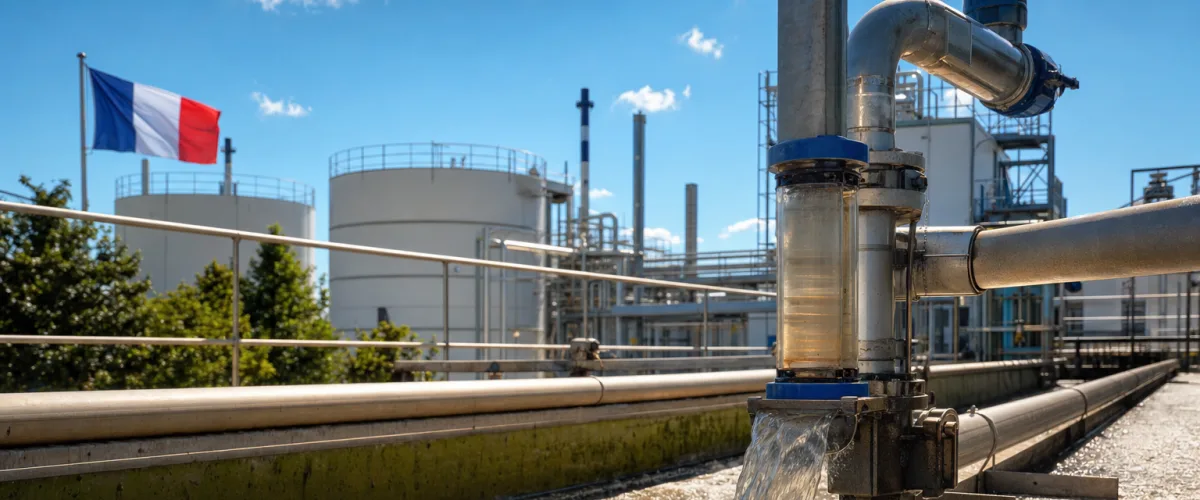
France's Minister of Ecological Transition published on July 25, 2026 the Arrete du 16 juillet 2026 on PFAS-containing liquid waste treatment in ICPE facilities under rubriques 2790 and 2791 (JORF n0172, NOR TECP2618033A). The order enters into force on July 26, 2026 and binds operators of hazardous and non-hazardous waste treatment sites that handle PFAS-laden liquid effluents to install abatement, sample monthly and meet a 4.4 ng/L PFOA-equivalent ceiling in the receiving environment.
Taken under articles L. 512-5 and L. 512-8 of the Code de l'environnement, the text finalizes the PFAS liquid-waste track opened by the November 25, 2024 arrete, following the public consultation of May 18 to June 7, 2026 and the opinion of the Conseil superieur de la prevention des risques technologiques of June 16, 2026. It is a national implementation layer, distinct from the still-awaited DDADUE loi transposing IED 2.0.
Who has to comply, and by when?
The order applies to ICPE installations under autorisation at rubrique 2790 (hazardous waste treatment) and to installations under declaration or autorisation at rubrique 2791 (non-hazardous waste treatment) that treat: landfill lixiviats from non-hazardous waste storage; firefighting water containing fluorinated emulseurs; runoff from areas where fluorinated firefighting foams were used in significant quantity; rinsing water from fire suppression systems using fluorinated emulseurs; and rinsing water from containers or equipment that contacted fluorinated emulseurs.
Operators must equip their installations with treatment devices designed, sized and operated to abate PFAS, robust to flow, temperature and composition variations, and run by a designated, trained competent person. Article 2 III sets a hard six-month deadline from entry into force to reach compliance. Crucially, until an installation meets these requirements it may not receive PFAS-containing liquid waste, and it is exempt from the discharge limit and monitoring duties of articles 3 and 4.
What is the discharge limit and how is it assessed?
The order introduces a PFOA-equivalent concentration logic: each PFAS measured is multiplied by its relative potency factor (RPF) and summed, with non-quantified results counted as zero. The substances covered are those listed in Annex I plus any other PFAS whose RPF is published on the INERIS chemicals site and that is technically quantifiable.
The maximal flux of Annex I PFAS discharged, whether directly to the environment or to a sewer and external wastewater treatment plant, must be compatible with the receiving environment. Compatibility is presumed if the concentration in the receiving environment stays at or below 4.4 ng/L PFOA-equivalent, or if the installation's contribution is non-significant under the Annex III method. Where compatibility cannot be met, the operator must define, on the basis of a techno-economic study, an action plan to bring the discharge into compliance, and keep that study and its progress status available to the ICPE inspectorate.
What are the sampling and reporting duties?
| Obligation | Frequency | Deadline |
|---|---|---|
| Sampling and analysis of aqueous discharges | At least monthly | First sample within 2 months of entry into force |
| External accredited laboratory analysis | At least quarterly | COFRAC or EA-MLA accredited actor |
| Results transmission via telesurveillance portal | Within 15 days of analysis report | Per arrete du 28 avril 2014 |
| Heightened monitoring on compatibility breach | Weekly for one month | Notify inspectorate, take corrective action |
Samples are taken at the discharge point before any dilution, over a 24-hour period. Where the compatibility threshold is breached, the operator steps up to weekly sampling for a month and resumes the monthly frequency only once compliance is restored. The prefect may modulate the monthly and weekly frequencies down to quarterly and monthly respectively where emission levels are demonstrably stable.
What should operators do next?
Audit each concerned installation against the Article 2 treatment-device requirements, plan the activated carbon, resin and membrane works within the six-month window, and cross-check the Annex I PFAS list against the INERIS RPF reference. Brief the ICPE permit and environmental compliance teams, the designated competent person, and the sampling laboratory on the new monthly cadence and the 15-day telesurveillance deadline. Obsidian's continuous, per-jurisdiction monitoring of the Legifrance feed surfaces this kind of national implementing text the day it publishes.