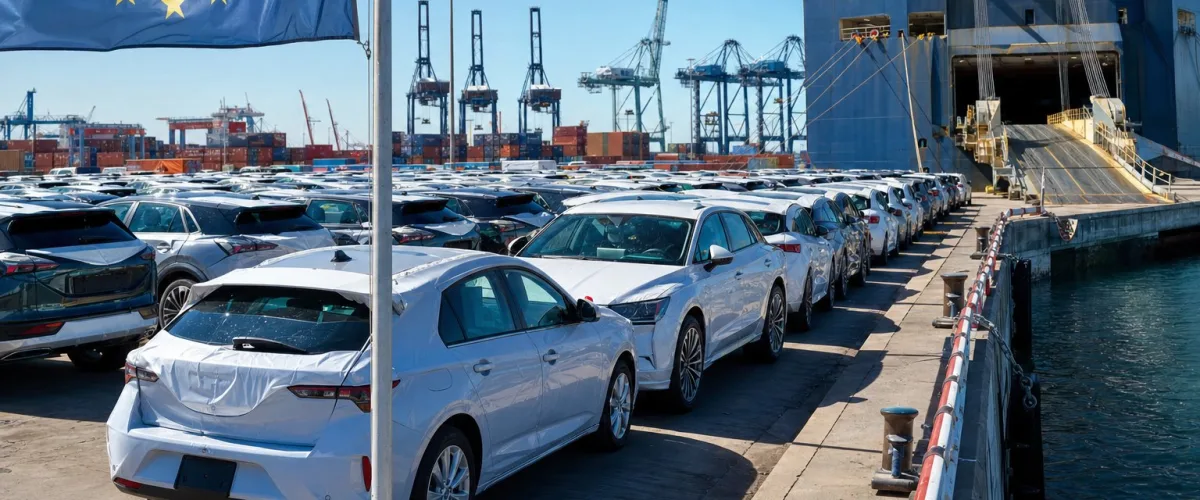
The European Commission adopted Commission Implementing Regulation (EU) 2026/2614 on November 23, 2026, published in the Official Journal on November 24, 2026, imposing provisional safeguard import quotas on hybrid passenger vehicles that apply from December 1, 2026. Adopted under the EU safeguard Regulations 2015/478 and 2015/755, following an investigation initiated on October 30, 2026, the act sets a maximum quantity of hybrid vehicles that may be imported into the EU for the duration of the provisional measure.
EU importers of hybrid passenger vehicles (HEVs, PHEVs and MHEVs), non-EU hybrid vehicle manufacturers exporting to the EU, EU distributors and dealers, and customs brokers must track country-specific quota allocations and the residual quota, keep import volumes within those ceilings, and prepare customs documentation for the provisional safeguard regime by December 1, 2026, or imports outside the quotas will be refused at the EU border with customs blocking and disruption of supply into the EU market.
Who is covered by the quotas, and from when?
The provisional safeguard measure covers full hybrid electric vehicles (HEVs), plug-in hybrid electric vehicles (PHEVs) and mild hybrid electric vehicles (MHEVs), and applies to all hybrid imports regardless of origin, not only to China. A provisional safeguard measure is a temporary quantitative restriction on imports, set per exporting country, that the European Commission imposes to protect EU industry from a sharp increase in imports while its safeguard investigation is underway. The Commission found that imports of hybrid passenger vehicles into the EU have increased significantly since 2023, driven by global production overcapacity and trade-restrictive measures in other major markets, putting the long-term viability of EU-based hybrid manufacturers at risk (press release IP/26/2564).
By market exposure, the actors covered are EU importers and their customs brokers handling hybrid vehicle entries, non-EU manufacturers exporting hybrids into the EU (notably Chinese, Japanese and Korean automakers), and EU distributors and dealers whose supply depends on inbound hybrid volumes. Countries holding more than 2% of EU hybrid imports in 2025 receive a country-specific quota; all other origins share a residual quota.
How are the quotas allocated?
The Commission sets a quantitative restriction in the form of import quotas per exporting country. Country-specific quotas are allocated to origins with a share of more than 2% of EU hybrid imports in 2025, and are set at the level of imports recorded from each such country in 2025, increased by a little over 15%. A residual quota covers all other origins. Imports outside these quotas are not allowed (Implementing Regulation (EU) 2026/2614).
| Quota type | Who receives it | Basis |
|---|---|---|
| Country-specific quota | Origins with >2% of EU hybrid imports in 2025 | 2025 import volume from that country, plus a little over 15% |
| Residual quota | All other origins | Shared residual ceiling |
What must importers do before December 1, 2026, and what comes next?
Importers and customs brokers must confirm the country-specific or residual quota that applies to each origin, monitor cumulative import volumes against the ceilings, and prepare the customs documentation the provisional safeguard regime requires, so that entries from December 1, 2026 onward stay within quota. The provisional measure will be in place for a maximum of 200 days. Definitive measures may be imposed within nine months from the initiation of the investigation on October 30, 2026 (investigation initiation notice), a timeline that can be extended by a maximum of two months.
The measure implements the understanding reached at the second EU-China Trade and Investment Consultations on October 9, 2026, under which China agreed to moderate its hybrid exports to the EU, but the quotas bind every origin. Obsidian tracks 23 regulatory texts (in force, amended or in preparation) for the Trade Compliance, Sanctions and Export Controls industry in European Union, as of November 2026.
What happens to imports outside the quotas?
Imports of hybrid passenger vehicles outside the allocated country-specific or residual quotas are refused at the EU border, with customs blocking and disruption of supply into the EU market. The provisional regime is a quantitative restriction, not an additional duty: the operative risk for importers is volume management, not a tariff charge. Continuous, per-jurisdiction monitoring surfaces this kind of change the moment it publishes in the Official Journal.
Importers should confirm which quota applies to each origin, track residual quota consumption as the provisional period progresses, and brief their trade compliance and customs teams ahead of December 1, 2026, with further quota and safeguard developments followed through Obsidian's EU trade compliance register.