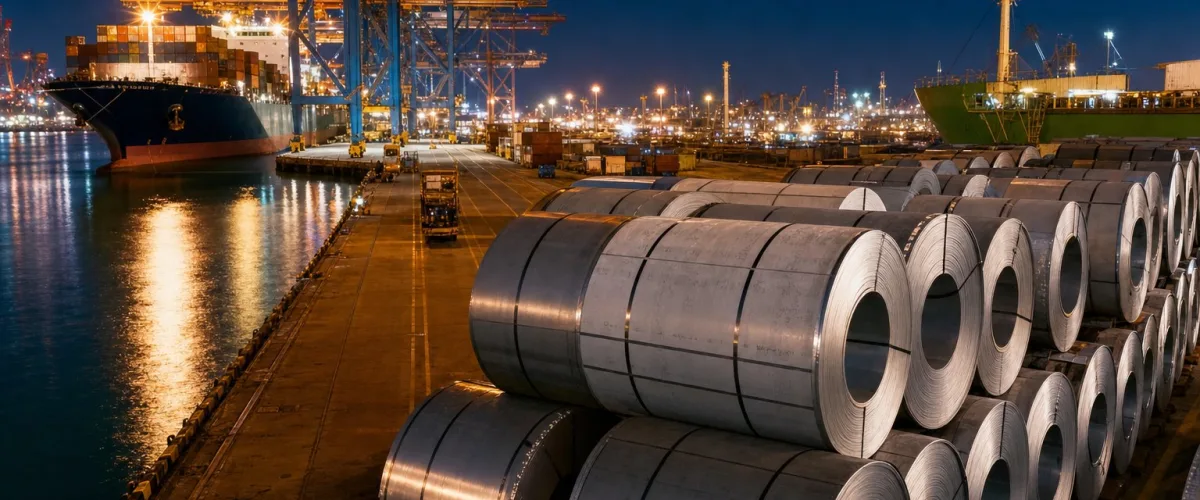
On November 16, 2026, the European Commission published Commission Implementing Regulation (EU) 2026/2547 in the Official Journal of the European Union, imposing a definitive anti-dumping duty on certain cold-rolled flat steel products originating in India, Japan, Taiwan, Türkiye and Vietnam. Adopted in Brussels on November 13, 2026, the regulation enters into force under Article 3 on the day after publication, which is November 17, 2026.
EU importers of cold-rolled flat steel originating in India, Japan, Taiwan, Türkiye and Vietnam, EU customs declarants filing the listed CN and TARIC codes, and EU vehicle, appliance and construction manufacturers that import this steel must declare the definitive anti-dumping duty on those codes and update customs values and supplier costings by November 17, 2026, or customs collect the unpaid anti-dumping duty and do not release the goods at the declared value. Exporting mills selling that steel into the EU, including Nippon Steel, JFE Steel, JSW Steel, Tata Steel, China Steel, POSCO Vietnam, Borçelik and Tatmetal, face the same duty on goods released for free circulation from that date. The rate applies to the net, free-at-Union-frontier price, before duty.
What does Regulation (EU) 2026/2547 impose?
Regulation (EU) 2026/2547 imposes the duty under Article 9(4) of Regulation (EU) 2016/1036 and does not collect it on imports released before November 17, 2026. A particular market situation exists where conditions in an exporting country's domestic market do not permit a proper comparison of domestic sales prices and export prices. The Commission established that situation in India, where government measures distorted the domestic iron ore price, and in Taiwan, where Chinese cold-rolled imports reached 38.2% of the market in the investigation period of July 1, 2024 to June 30, 2025. It constructed normal value under Article 2(3). For Japan it found no particular market situation from Chinese imports, which held a 2.2% share.
Article 1 covers cold-rolled flat products of iron, non-alloy steel or other alloy steel, stainless excluded, not clad, plated or coated. It leaves out electrical steel, black plate, silicon-electrical steel and high-speed steel. CN codes: ex 7209 15 00, 7209 16 90, 7209 17 90, 7209 18 91, ex 7209 18 99, ex 7209 25 00, 7209 26 90, 7209 27 90, 7209 28 90, 7211 23 30, ex 7211 23 80, ex 7211 29 00, 7225 50 80, 7226 92 00. TARIC codes: 7209 15 00 90, 7209 18 99 90, 7209 25 00 90, 7211 23 80 19, 7211 23 80 95, 7211 23 80 99, 7211 29 00 19, 7211 29 00 99.
No provisional duty was imposed. The Commission refused retroactive collection under Article 10(4), so registration under Implementing Regulation (EU) 2025/2432 does not tax entries before November 17, 2026. See the Commission notice of November 16, 2026.
Who must declare the duty, and on what proof?
The importer of record, or the representative who files the declaration, must book the duty when the goods are released for free circulation. A mill that sells delivered-duty-paid shifts the cash cost, not the customs debt. Vehicle, appliance and construction manufacturers that import the flat product themselves file in their own name.
A company rate applies only to the legal entity named in Article 1(2), and only with the signed invoice declaration in Article 1(3) (tonnes, manufacturer, address, TARIC additional code, country). Without it, customs charge the residual country rate. A related mill that is not named does not take the named rate.
Obsidian has recorded 9 dated steps in the life of EU Trade Defence Instruments since March 11, 2015, as of November 2026. Per-jurisdiction monitoring of the Official Journal is what puts a duty of this kind in front of a customs desk on the publication day.
Which rate applies to each mill?
The duty is the lower of the dumping margin and the injury margin. India is 9.5% for every Indian producer, including JSW Steel Limited and JSW Steel Coated Products Limited. Japan is 27.9% for every Japanese producer, including Nippon Steel Corporation and Daido Steel Co., Ltd., below a 54.7% dumping margin.
| Origin | Producer | Duty | Code |
|---|---|---|---|
| India | All producers, including JSW Steel | 9.5% | 88GB or 8999 |
| Japan | All producers, including Nippon Steel and Daido | 27.9% | 88GD or 8999 |
| Taiwan | China Steel Corporation, Chung Hung Steel and other cooperating companies | 20.7% | 88GG or annex |
| Taiwan | All other imports | 27.0% | 8999 |
| Türkiye | Borçelik Çelik Sanayi Ticaret A.Ş. | 7.8% | 88GI |
| Türkiye | Tatmetal Çelik Sanayi ve Ticaret A. Ş. | 3.0% | 88GJ |
| Türkiye | Other cooperating companies / all other imports | 4.9% / 7.8% | annex / 8999 |
| Vietnam | POSCO VIETNAM CO., LTD and all other imports | 16.0% | 88GO or 8999 |
A Taiwanese line without the Article 1(3) invoice pays 27.0%, not 20.7%. A Tatmetal line without it pays 7.8%, not 3.0%. The annex names the other cooperating companies.
What happens if the declaration omits the duty?
Customs collect the unpaid anti-dumping duty and do not release the goods at the declared value. Article 1(4) brings in the ordinary customs-debt rules, including post-clearance recovery where origin, producer or TARIC additional code was wrong. Goods already in free circulation before November 17, 2026 stay outside the duty.
Match each open order to origin, CN and TARIC code, named producer and the Article 1(3) invoice, and book the rate before November 17, 2026. Obsidian holds the Official Journal text and the company codes for the next amendment.