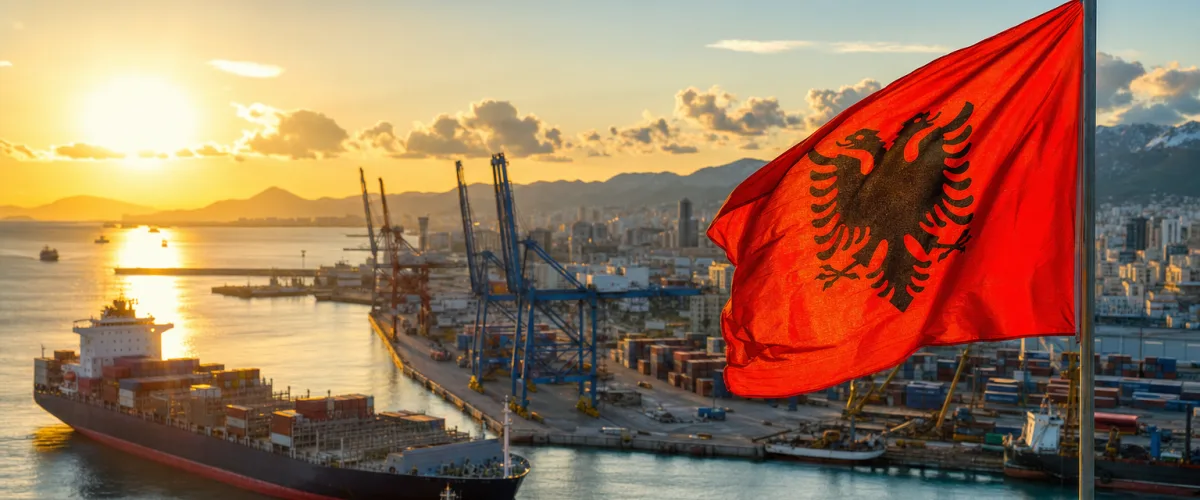
On August 25, 2026, Albania's Ministry of Infrastructure and Energy opened public consultation on a draft decision adopting a regulation on the monitoring, reporting and verification (MRV) of greenhouse gas emissions from maritime transport. The draft establishes, for the first time at national level, a binding MRV framework for ships calling at Albanian ports, approximating EU Regulation 2015/757 on the MRV of carbon dioxide emissions from maritime transport.
The consultation bundles the full draft text (Projektvendimi), an explanatory report (Relacion shpjegues), and an English concordance table mapping each national provision to its EU 2015/757 counterpart. The concordance table is the quickest signal that this is a transposition-style alignment, not a free-standing national scheme.
Who must monitor and report emissions under the draft regulation?
The draft brings ships calling at Albanian ports into an MRV obligation modelled on the EU regime, which applies to vessels above 5,000 gross tonnage. In practice the must-act audience is concrete and identifiable: Adriatic ferry operators serving Durres, including Adria Ferries, Ventouris Ferries and Grandi Navi Veloci (GNV), the Albanian-flagged fleet, and the port authorities that administer calls and berthing. Ro-ro and passenger ferries on the Italy-Albania corridor are the most exposed commercial segment, because their regular Durres calls put them inside the regulation's territorial hook on every voyage.
Albania is not an EU Member State, so EU Regulation 2015/757 has no direct effect there. The legal hook for alignment is Article 70 of the Stabilisation and Association Agreement, under which Albania progressively approximates its legislation to the EU acquis through the National Plan for European Integration. The instrument here is a national Council of Ministers decision (VKM), not the reception of the EU text itself.
What does the MRV cycle require operators to do?
The draft transposes the four-step MRV architecture familiar from the EU regime. Companies must prepare a ship-specific emissions monitoring plan covering the methods, sources and procedures used to capture fuel consumption and emissions data. They must then monitor and record CO2 emissions per ship, per voyage and annually, using the methods established under 2015/757 (bunker fuel delivery notes, tank readings, direct measurement, or a combination), which the concordance table maps onto the national text.
The collected data must be aggregated into an annual emissions report, which an accredited verifier must check before it is submitted to the competent authority. Only a verified report discharges the company's obligation for the reporting year.
| MRV step | Operator obligation | EU 2015/757 benchmark |
|---|---|---|
| Monitoring plan | Draft and submit a per-ship plan | Required before monitoring begins |
| Data collection | Record emissions per voyage and annually | Bunker notes, tank readings or direct measurement |
| Verification | Independent verifier confirms the report | Accredited MRV verifier |
| Submission | File the verified report with the authority | Annual, by the EU deadline |
How does the draft relate to Albania's wider climate track?
The maritime MRV draft sits inside Albania's well-telegraphed EU-accession climate alignment: the Energy Community 2030 targets, accession Chapter 27 (environment) and Chapter 14 (transport), and the updated National Energy and Climate Plan. Independent regional trade press (Balkan Green Energy News) has already covered the draft as a 2015/757 transposition with 2026 implementation, which signals moderate anticipation rather than a surprise move.
The draft is distinct from two awaited milestones on the same track: Council of Ministers adoption of the updated NECP, and parliamentary adoption of the amended Law on Climate Change (Law 155/2020), which would transpose the broader MRV-accreditation and ETS acquis. This regulation is the maritime-specific layer under the Ministry of Infrastructure and Energy, not the primary-law amendment.
When does consultation close and what comes next?
The consultation notice does not fix a closing date in its text. Contributions can be submitted through the electronic public-consultation register at konsultimipublik.gov.al, by post to the Ministry in Tirana, or by email to the public-consultation coordinator. After consultation closes, the Ministry is expected to finalise the draft for adoption by the Council of Ministers; once signed by the Prime Minister and published in the Fletorja Zyrtare (Official Gazette), the regulation enters into force on the date it fixes.
For operators, continuous per-jurisdiction real-time monitoring surfaces a change like this the moment the Ministry publishes it, rather than when the verified report is already due, which is where Obsidian keeps watch on this draft through to gazette publication.
Next steps for affected teams: confirm which of your vessels call at Albanian ports and check the draft's tonnage threshold against the EU 5,000 GT benchmark, map your existing EU MRV monitoring plans against the Albanian concordance table to spot gaps, designate a verifier relationship before the first reporting year, and brief your port-call and bunkering teams on the new documentation chain.