

If you work in sustainability and ESG reporting, the ground keeps moving under you. CSRD pulled a wave of companies into mandatory reporting, then the Omnibus simplification changed who is in scope and when, while the EU Taxonomy, SFDR, the CSDDD and CBAM each carry their own thresholds and dates. Ask an AI assistant to confirm any of it and the answer comes back fluent and often out of date: a scope rule from before the simplification, a deadline that has since shifted, a measure quoted as binding when it is still a proposal.
The models you already use reason about ESG rules perfectly well. What fails them is reach: a general model cannot open the current consolidated text or know what the latest amendment changed. Give it that text, and it stops guessing.
That text is what Obsidian supplies, deep and current on EU sustainability law. We put the models through hundreds of complex ESG tasks across CSRD, the ESRS, the EU Taxonomy, SFDR, the CSDDD and CBAM, each handled alone and connected to Obsidian.
AI is inaccurate on ESG regulation
Alone, the models averaged 72 out of 100. Connect them to Obsidian and the average climbs to 90. The models did not change between those two numbers. Only the data in front of them did.
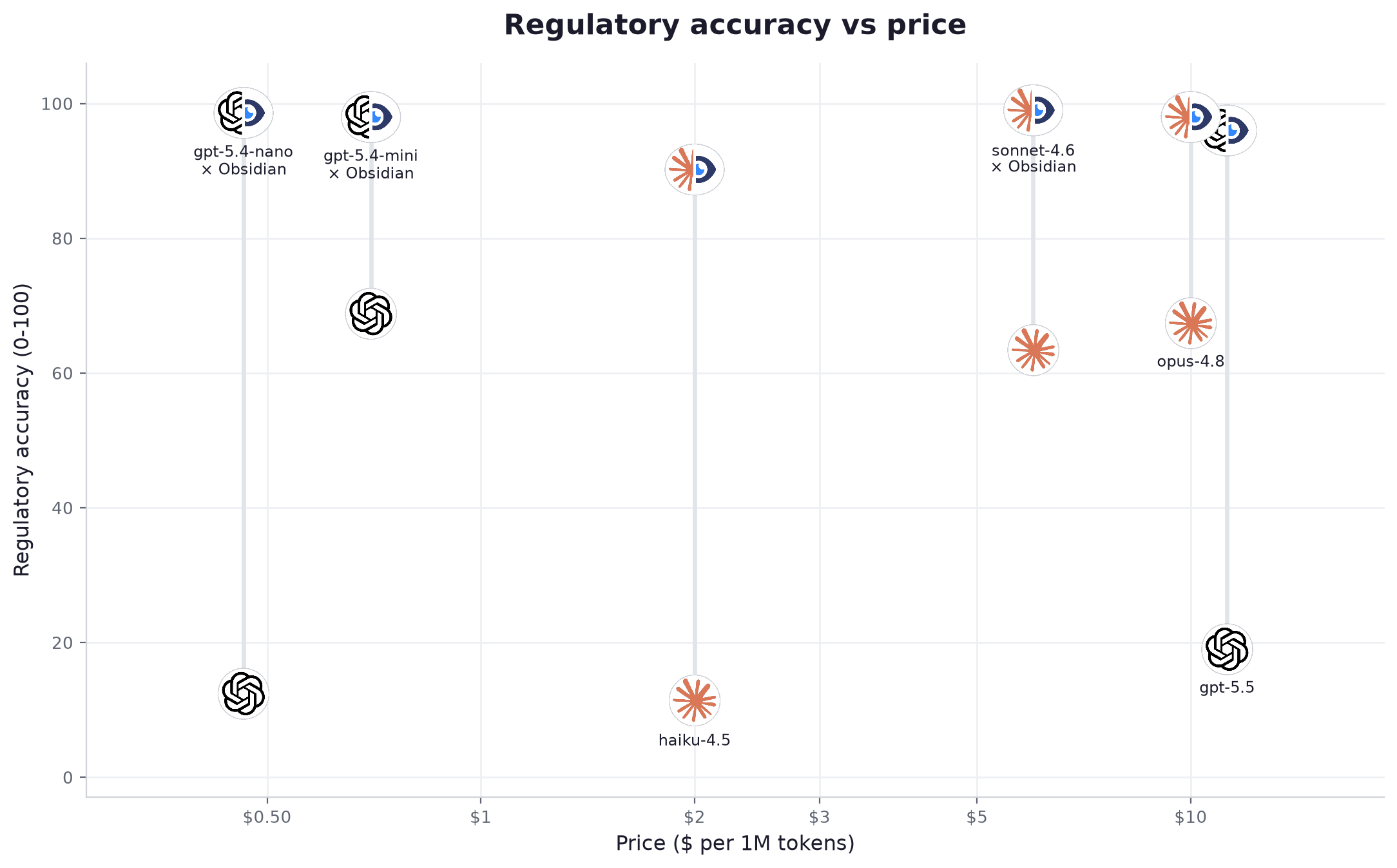
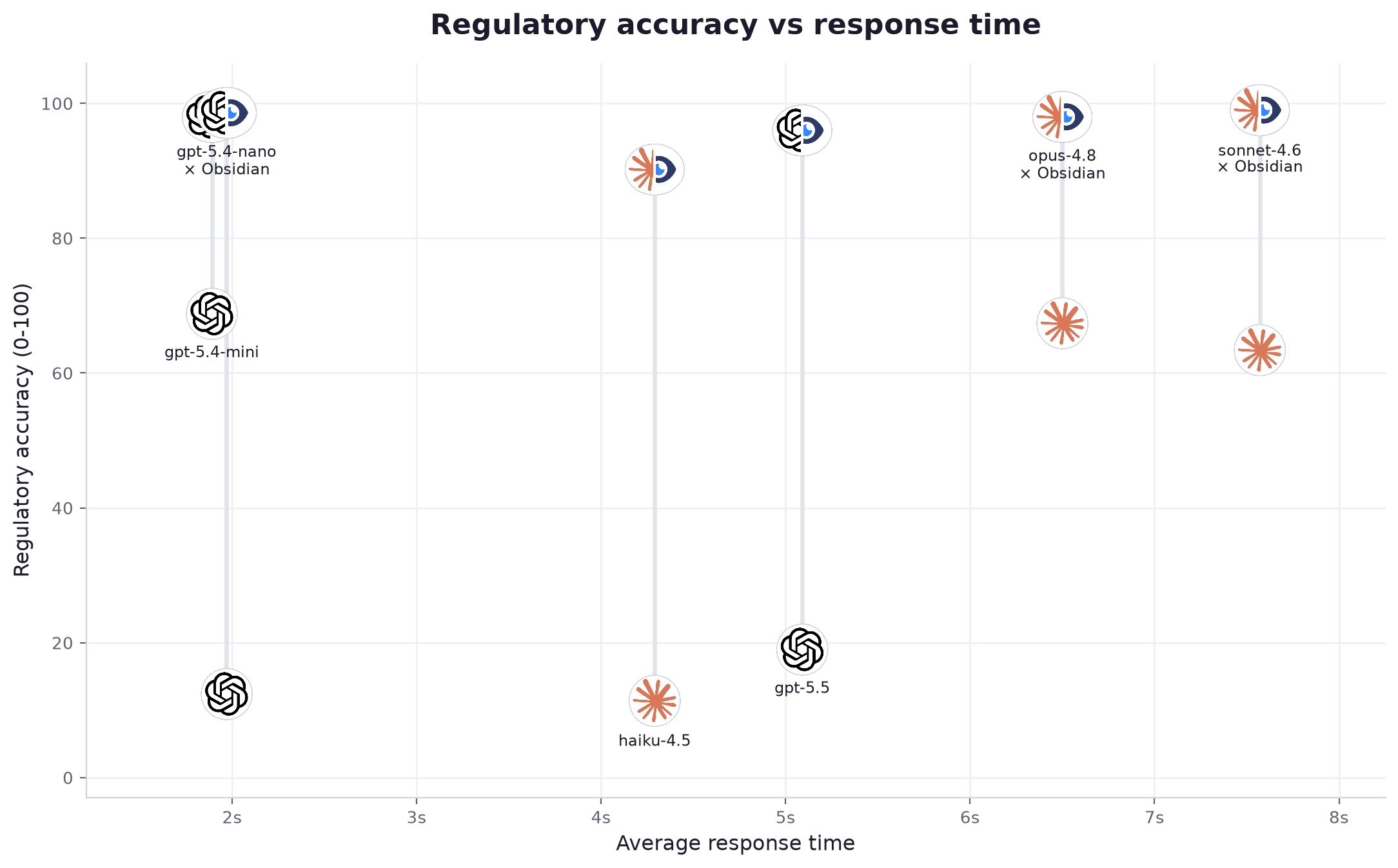
ESG is the domain where general models look strongest on their own, because the frameworks are discussed everywhere, and that is exactly what makes the result matter: even here the model misses the current scope, the post-simplification thresholds and whether a measure is actually in force. The data layer closes that gap. gemini-3.1-flash-lite, at $0.175 per million tokens, climbs from 70 to 95 once connected, the top score in the table and ahead of every model many times its price. A light-tier model connected to Obsidian beat a frontier model answering alone in 16 of 16 head-to-head pairings on the ESG set.
AI cannot point you to the official ESG source
For a sustainability team the citation is the deliverable. Connected to Obsidian, an answer arrives with the official instrument attached, the directive or regulation behind CSRD, the Taxonomy, SFDR or the CSDDD, with its current status and a direct link. Alone, you get a plausible reference you then have to chase down and date-check yourself, on a field where the version and the in-force status are the entire answer.
An answer with the tier-0 source attached is one you can forward to an auditor without re-checking it. That is the difference between a draft a model imagined and an obligation you can act on.
AI hallucinates
We broke every answer into its individual factual claims and checked each against the official source. The gap between the two grounded-claim numbers above is what matters on a field where a wrong deadline or a draft mistaken for binding law becomes a misstatement in a published report. What disappears is the confident claim with nothing behind it; the ungrounded remainder is added context, not invented references.
The full data, for the purists
Every model, both conditions. "Alone" is the model with no data layer; "with Obsidian" is the same model connected. Accuracy is a 0 to 100 score from a blind judge against human-verified ground truth. "Grounded claims" is the share of the answer's atomic factual claims that trace back to the official source, alone versus with Obsidian.
| # | Model | Provider | Tier | Acc. alone | Acc. + Obsidian | Lift | Cites source | Status correct | Grounded claims (alone → +Obs) | Latency | Speed | Price /1M | Cost / question |
|---|---|---|---|---|---|---|---|---|---|---|---|---|---|
| 1 | gemini-3.1-flash-lite | light | 69.5 | 94.6 | +25.1 | 96% | 100% | 23% → 98% | 0.86s | 127 tok/s | $0.175 | $0.000188 | |
| 2 | gpt-5.4-nano | OpenAI | light | 56.8 | 93.7 | +36.9 | 90% | 98% | 41% → 93% | 1.59s | 75 tok/s | $0.463 | $0.000408 |
| 3 | gpt-5.4-mini | OpenAI | mid | 84.4 | 93.6 | +9.2 | 94% | 100% | 41% → 99% | 1.33s | 84 tok/s | $0.7 | $0.000689 |
| 4 | opus-4.8 | Anthropic | advanced | 81.1 | 93.3 | +12.2 | 96% | 100% | 24% → 87% | 5.94s | 65 tok/s | $10.0 | $0.019428 |
| 5 | sonnet-4.6 | Anthropic | mid | 81.0 | 92.6 | +11.6 | 94% | 100% | 24% → 73% | 7.83s | 49 tok/s | $6.0 | $0.009912 |
| 6 | haiku-4.5 | Anthropic | light | 58.9 | 90.3 | +31.4 | 93% | 100% | 23% → 87% | 3.01s | 77 tok/s | $2.0 | $0.002546 |
| 7 | gpt-5.5 | OpenAI | advanced | 74.2 | 89.7 | +15.5 | 95% | 100% | 45% → 93% | 5.2s | 44 tok/s | $11.25 | $0.014132 |
| 8 | grok-3-mini | xAI | light | 69.0 | 87.0 | +18.0 | 96% | 100% | 36% → 88% | 3.27s | 126 tok/s | $0.35 | $0.000617 |
| 9 | grok-4.20-reasoning | xAI | advanced | 77.7 | 86.8 | +9.1 | 91% | 95% | 30% → 88% | 3.04s | 214 tok/s | $6.0 | $0.015101 |
| 10 | grok-4.3 | xAI | mid | 74.0 | 86.4 | +12.4 | 88% | 95% | 36% → 88% | 3.2s | 126 tok/s | $1.562 | $0.002703 |
| 11 | gemini-3.1-pro | advanced | 69.3 | 86.0 | +16.7 | 88% | 95% | 31% → 96% | 6.21s | 107 tok/s | $6.0 | $0.016565 | |
| 12 | gemini-3.5-flash | mid | 67.9 | 83.7 | +15.8 | 90% | 95% | 29% → 92% | 3.41s | 180 tok/s | $3.375 | $0.0089 |
On ESG, models already score well from public discussion alone, which makes the connected accuracy and the grounded-claim jump the harder tests, and the data layer clears both.
How we measured it
- The full model set from Anthropic, OpenAI, Google and xAI.
- Hundreds of complex ESG tasks across CSRD, the ESRS, the EU Taxonomy, SFDR, the CSDDD and CBAM, each tied to its official reference and current status. Tasks outside Obsidian's current ESG coverage are set aside, so the score reflects answer quality.
- Two conditions: the model alone, and connected to Obsidian.
- A blind judge scores each answer; grounded claims come from a separate per-claim check against the official source.
Put the official ESG source behind every answer
Connect Obsidian to the AI you already use and every CSRD, Taxonomy or SFDR answer comes back with its official instrument, date and current status. Free tier, two-minute setup.
Explore the Obsidian data layerWhat this means
You do not need a more expensive model, and you do not need to accept guesses on a rulebook that moves every quarter. The assistant your team already uses, given verified ESG data, answers with the current instrument attached, so a sustainability lead can act on it instead of re-checking it. The background is here too: ESG and CSRD regulatory intelligence and tier-0 regulatory data. The full cross-industry results are in the regulatory AI benchmark. To test it on your own questions, connect the Obsidian regulatory data layer.


