Iceland's Ministry of Infrastructure (Innviðaráðuneytið) published Reglugerð nr. 950/2026 on the marking and lighting of obstacles for the protection of aircraft in flight in Stjórnartíðindi B-deild on September 2, 2026, and the regulation entered into force the same day with no transition period. Issued under §§ 152 and 186 of the Aviation Act nr. 80/2022, it sets minimum marking, lighting, notification, safety-assessment and maintenance duties for obstacles outside airport influence areas, and binds every owner of a structure that can be equated to an obstacle.
The regulation nationalises the obstacle-marking guidance in EASA GM Chapter Q of Regulation (EU) 139/2014 and the data-quality requirements of Regulation (EU) 2017/373, transposed in Iceland through reglugerð nr. 75/2016 and nr. 720/2019. Samgöngustofa, the Icelandic Transport Authority, is the sole supervisor, exemption granter and enforcement body.
Which structures must now be marked, lit and notified?
Three height thresholds drive the obligations, and they apply immediately to existing and new structures alike. Any obstacle 50 metres or taller must be notified electronically to Samgöngustofa and the aviation information-service provider, with details of its nature, location, height and width, so it can be charted in AIP Iceland and on flight maps. Any obstacle 60 metres or taller must carry colour marking. Any obstacle 100 metres or taller must additionally carry obstacle lights.
| Height threshold | Obligation triggered |
|---|---|
| 50 m and above | Notify Samgöngustofa (permanent or temporary obstacle) |
| 60 m and above | Colour marking under §5 |
| 100 m and above | Obstacle lights under §7 |
| 150 m and above | Intermediate lights, max 75 m vertical spacing; high-intensity type B |
Owners, municipalities and planning authorities share the notification duty. If an owner fails to supply adequate data, Samgöngustofa can have the obstacle measured at the owner's expense, and it alone decides whether a structure counts as an obstacle when there is a dispute.
What marking and lighting standards apply?
Colour markings must be visible in daylight from at least 1,500 metres and must be red or yellow, or a red-and-white or yellow-and-white checker, in line with EASA Chapter Q. All markings must be reflective, except those on wind turbines. Large surfaces (4.5 m or more across) use a rectangular checker pattern; narrower obstacles use horizontal bands, 6 m wide for structures from 60 to 200 m and 10 m wide above 200 m.
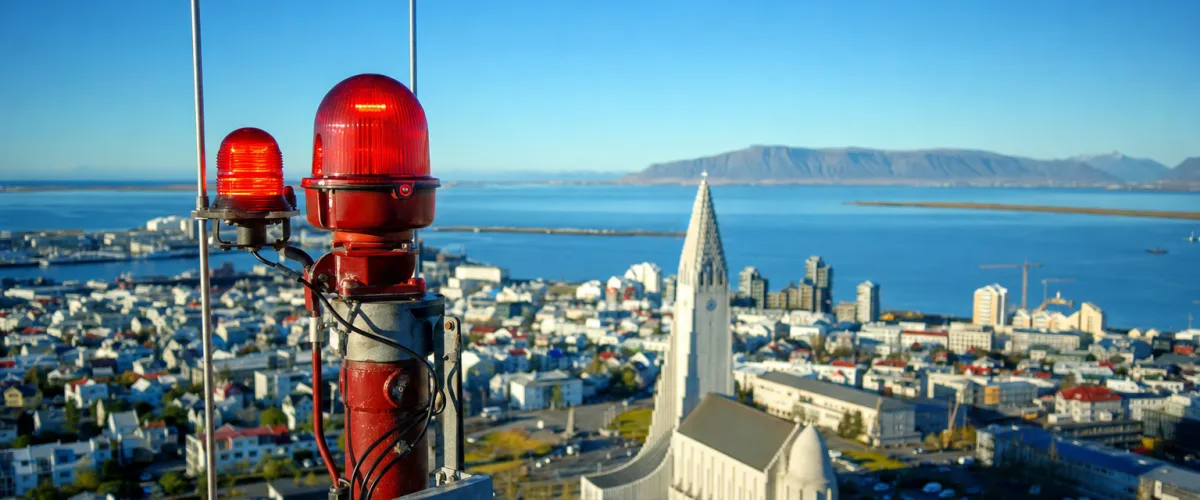
Obstacle lights sit at the top of the obstacle and must be visible from all directions. The regulation prescribes low, medium and high-intensity types A, B and C. High and medium-intensity type A lights must burn around the clock or use an approved automatic system that switches them on when ambient light drops below 500 cd/m². LED lights must emit both visible light and infrared, so they stay visible to pilots using night-vision equipment. Lights must be operational at least 95 percent of the time, measured as an annual average, and failures must be reported immediately to the aviation information-service provider by email.
What must wind farm and power line operators do?
Wind turbines must be painted a light colour such as grey or grey-white (RAL 7035 is cited), never snow white, though the bottom third of the tower is exempt. Turbines 100 m or taller need two obstacle lights on the nacelle. For wind farms of three or more turbines, Samgöngustofa may permit only the perimeter machines to be lit, provided spacing is no more than 900 metres, and all lights in a farm must flash in sync. Turbines from 100 to 150 m use medium type B or C lights; those above 150 m use high-intensity type B.
For overhead lines, masts must be colour-marked when the line reaches 60 m, line markers are required from 100 m, and end masts need medium type B lights from 150 m. Parallel lines within 90 m of each other count as a single obstacle. The duties reach the operators most exposed to this rule: the transmission system operator Landsnet, power utilities Landsvirkjun, ON Power and HS Orka, wind developer IthunnH2, telecom tower operators Síminn and Nova, and the airport operator Isavia.
How is the rule enforced, and can operators obtain an exemption?
Under §12, Samgöngustofa can require the removal or marking of any obstacle it deems dangerous to air traffic, relying on §150 of the Aviation Act. It also charges time-based fees for processing exemption requests and registering obstacles, regardless of whether an exemption is granted, and the applicant bears any test-flight costs.
Exemptions are possible but normally temporary. An owner must submit a safety assessment showing the deviation does not compromise aviation safety, and Samgöngustofa can demand a proving flight at the owner's expense. Obstacles up to 150 m can, with a safety case, be exempted from colour marking and lighting, and Samgöngustofa may define remote zones where the marking duty only bites at 150 m. Because the regulation took effect on publication, owners of covered structures are already on the clock.
Continuous, per-jurisdiction real-time monitoring, as Obsidian provides, surfaces a rule like this the moment it publishes in the official journal, before it reaches trade press. Operators should now confirm which of their assets cross the 50, 60 or 100 m thresholds, verify that markings and lights meet the EASA Chapter Q references, and brief the teams responsible for aviation-safety compliance and asset maintenance.