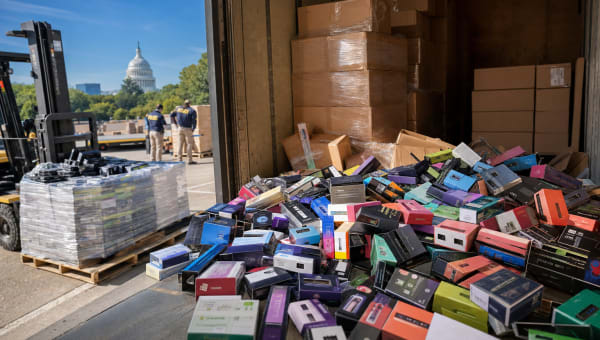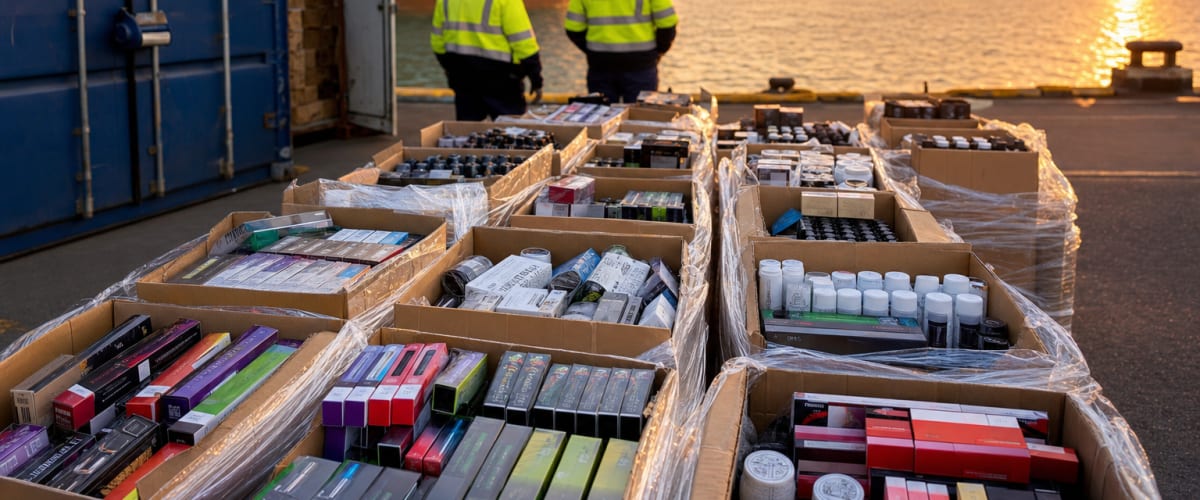
On July 16, 2026, the Therapeutic Goods Administration (TGA) led a multi-agency crackdown across Darwin, executing search warrants that seized almost AUD 750,000 worth of illegal nicotine products. The operation, conducted with NT Health, the Darwin Tobacco and Tobacco-Related Products enforcement team and Northern Territory Police, recovered more than 6,000 illegal vaping goods, over 17,900 nicotine pouches, more than 350,000 illicit cigarettes and over 280 kilograms of loose-leaf tobacco from a retail premises and two associated storage units. For Australian tobacco and vape retailers, the action is the sharpest signal yet that the January 2024 vaping reforms are being enforced at the point of sale, not only at the border, according to the TGA media release.
The seized goods came from a single retail operation rather than a border interception, which distinguishes this Darwin action from the larger Australian Border Force (ABF) hauls. Since the vaping reforms took effect in January 2024, the TGA and ABF have together seized more than 23.8 million illegal vaping goods with an estimated street value of AUD 1 billion. The Darwin case shows enforcement now reaching downstream into retail supply chains.
Who is allowed to sell vapes in Australia, and who is not?
Under the vaping provisions of the Therapeutic Goods Act 1989, it is illegal for any retailer other than a participating pharmacy to sell any kind of vape. Tobacconists, convenience stores and general retailers are expressly prohibited from selling vaping goods, regardless of nicotine content. Nicotine pouches fall under the same unauthorized-supply prohibition when sold outside the pharmacy channel.
The Darwin seizure targeted precisely this category of non-pharmacy retail supply. Businesses that continue to stock vapes, nicotine pouches or illicit tobacco on the assumption that the reforms target only importers are misreading the enforcement posture: the warrants were executed at a retail premises and its storage units, not a warehouse or port.
What penalties apply, and how severe are they?
Non-compliance with the vaping provisions in the Therapeutic Goods Act 1989 can attract significant penalties per offence: imprisonment for up to 7 years, fines of up to AUD 2.55 million for individuals, or fines of up to AUD 25.5 million for corporations. Each offence is charged separately, so a retailer holding multiple categories of illegal product faces stacked liability.
| Offender | Maximum penalty per offence |
|---|---|
| Individual | AUD 2.55 million, or imprisonment up to 7 years |
| Corporation | AUD 25.5 million |
The penalties sit on top of any territory-level tobacco licensing and illicit-tobacco offences enforced by NT Health and police, meaning a single raid can trigger parallel Commonwealth and Territory proceedings against the same operator.
What should exposed retailers do now?
Businesses operating in the tobacco, vape, convenience and pharmacy-adjacent retail space should treat the Darwin operation as a compliance trigger, not an isolated incident. The TGA explicitly invited the public to report illegal supply through its breach-reporting channel, and multi-agency coordination across the TGA, state and territory health authorities and police is now the operating model.
Practical steps: audit current stock for any vaping goods, nicotine pouches or illicit cigarettes held outside a pharmacy authorization; remove non-compliant inventory; verify that any nicotine product sold is supplied through a participating pharmacy under the Therapeutic Goods Act framework; and brief front-line staff that tobacconist and convenience-store vape sales are prohibited regardless of customer demand. Continuous, per-jurisdiction real-time monitoring surfaces this kind of enforcement shift the moment a regulator publishes it.
Follow this topic in real time with a free monitoring job
What to do next
Verify whether your outlets hold any unauthorized nicotine or tobacco stock, confirm your pharmacy-channel authorization if you sell vapes, and brief compliance and retail-operations leads on the AUD 25.5 million corporate exposure per offence. The TGA has signaled that coordinated, multi-agency retail enforcement will continue, and Obsidian tracks each new release as it publishes.