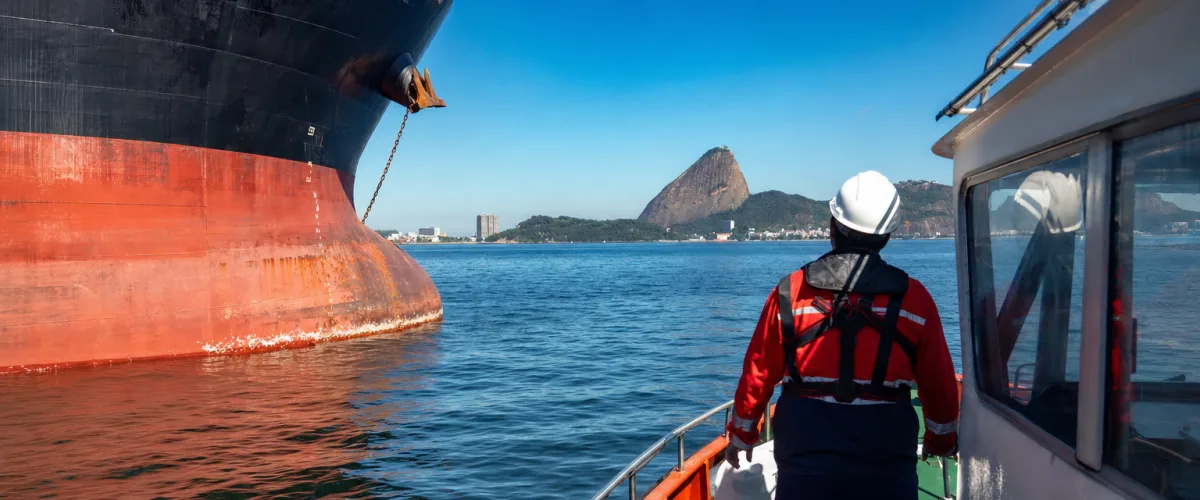
On June 3, 2026, the Brazilian Navy's Directorate of Ports and Coasts published Portaria DPC/DGN/MB No. 476/2026, granting what it explicitly called the final and definitive extension for penalties under NORMAM-401's biofouling chapter, pushing enforcement to January 10, 2028. Three weeks later, across the Atlantic route those same vessels sail, the EU Emissions Trading System's phase-in for shipping reached 100% coverage, meaning a Brazilian iron ore carrier bound for Rotterdam now owes allowances on the full extra-EU exposure rate rather than the 70% it paid in 2025. One regulator is buying time, the other has stopped phasing in.
That contrast defines maritime compliance in South America right now. National maritime authorities from Brasilia to Bogota are absorbing new IMO conventions into domestic law at their own pace, port state control runs through a regional agreement most compliance teams outside the region have never heard of, and the international rules the ships answer to abroad are moving faster than the ones at home. A fleet operator trading soybeans out of Santos, iron ore out of Ponta da Madeira and copper out of San Antonio is not tracking one regulatory clock, but at least four.
Which authorities actually enforce maritime rules in South America?
Each coastal state runs its own navy-linked maritime authority, and none of them defers to a regional regulator for domestic enforcement. Brazil's Marinha do Brasil, through its Directorate of Ports and Coasts (DPC), issues the NORMAM series of maritime authority standards and enforces them in Brazilian Jurisdictional Waters. Argentina's Prefectura Naval Argentina (PNA) holds the equivalent role as coastal, flag and port state, and modernized its vessel documentation regime through Decreto 37/2025 (REGINAVE), which took effect January 1, 2026. Chile's Directorate General of the Maritime Territory and Merchant Marine (DIRECTEMAR) combines navigation safety, seaworthiness inspection and pollution enforcement in one agency, and hosted the IMO's own regional workshop on MARPOL Annex VI implementation in Viña del Mar. Colombia's Dirección General Marítima (DIMAR) and Mexico's Secretaria de Marina (SEMAR), reorganized by presidential decree on December 11, 2025 to create a dedicated Undersecretariat of Maritime and Port Affairs, round out the five largest maritime administrations in the region.
What ties them together operationally is the Acuerdo Latinoamericano de Viña del Mar, the 1992 regional port state control agreement whose secretariat and inspection database, CIALA, are hosted by the Argentine Prefectura Naval. Fifteen states participate, and a detention issued by DIMAR in Cartagena or DIRECTEMAR in Valparaiso is treated as regional intelligence the way a Paris MoU detention is treated in Europe. A compliance team that only watches its flag state's rules misses the port state exposure that actually determines whether a vessel gets detained.
Is Brazil's new ballast water and biofouling rule already enforceable?
Yes, with a narrow and now-final exception. NORMAM-401/DPC, the Brazilian Maritime Authority's consolidated standard on environmental pollution prevention, has required the D-2 ballast water performance standard, meaning treatment rather than open-ocean exchange, since September 8, 2024. Ships without a valid exemption certificate (Cisen) must comply now, not on some future date. What Portaria DPC/DGN/MB No. 476/2026 postponed is narrower: the specific penalties and sanctions tied to Chapter 4's biofouling and anti-fouling system provisions, extended to January 10, 2028, after an earlier date of June 10, 2026 proved too tight for the market to absorb hull-cleaning capacity at Brazilian ports and shipyards.
The Navy was explicit that this is the last extension it will grant, and that the underlying rule remains in force regardless of the penalty timeline: operators must still maintain biofouling management plans and records from the regulation's effective date. A vessel operator that reads the 2028 date as a green light to defer hull inspections is misreading a grace period on enforcement as a grace period on the obligation itself.
How does the EU ETS's 2026 full phase-in hit South American exporters?
Materially, and specifically on the routes carrying the region's largest export volumes. Under the EU's 2023 ETS extension to shipping, the surrender obligation rose from 40% of reported emissions in 2024 to 70% in 2025 and reached 100% in 2026, the year the phase-in schedule was designed to complete. Because voyages between a non-EU port and an EU port count only 50% of emissions toward the surrender obligation, an East Coast South America to Europe iron ore or grain voyage sits at that 50% exposure rate rather than the 100% rate applied to intra-EU legs, but at a 2026 EU Allowance price in the €74 to €90 per tonne range, that exposure still adds up: industry cost models put a Panamax-class iron ore voyage with roughly 55% EU-touching emissions at close to 1.9 million euros in annual allowance cost for a single ship at full 2026 implementation.
| Jurisdiction / regime | Status as of mid-2026 | Key date to track |
|---|---|---|
| Brazil, NORMAM-401/DPC (ballast water, biofouling) | D-2 standard in force; Chapter 4 penalties deferred | Penalties apply from January 10, 2028 |
| Brazil, BR do Mar cabotage program | Regulated by Decree 12,555/2025; ANTAQ rules rolling out | EBN/REB authorizations ongoing through 2026 |
| Argentina, REGINAVE (Decreto 37/2025) | In force; new Declaracion de Cumplimiento replaces old certificate | Effective January 1, 2026 |
| Colombia, BWM Convention (Law 2362 of 2024) | Ratified; DIMAR resolutions 477/2012 and 247/2022 remain operative | In force since 2024 ratification |
| IMO Net-Zero Framework (MARPOL Annex VI, Chapter 5) | Adoption postponed from October 2025 | Extraordinary session set for December 4, 2026 |
| EU ETS maritime (extra-EU voyages) | Phase-in complete, 50% of extra-EU emissions covered | 100% surrender obligation from 2026 reporting year |
What is actually at stake in the IMO Net-Zero Framework vote for the region?
A structural disagreement over who bears the cost of the global fuel transition, not a technical footnote. The Marine Environment Protection Committee approved the Net-Zero Framework in principle at MEPC 83 in April 2025, built around a global fuel intensity standard and a two-tier pricing mechanism, with remedial unit prices proposed at 100 dollars per tonne of CO2 equivalent for Tier 1 shortfalls and 380 dollars for Tier 2. The extraordinary session convened to adopt it in October 2025 adjourned without a vote after opposition led by the United States, and MEPC 84, held in London from April 27 to May 1, 2026, closed with IMO Secretary-General Arsenio Dominguez telling delegates the organization was back on track but needed to rebuild trust. Two intersessional working groups, in September and late November 2026, now feed into MEPC 85 (November 30 to December 3, 2026) and a resumed extraordinary session reserved for December 4, 2026.
Argentina and Panama were among the delegations that pushed a substantially different proposal during the 2026 negotiations, and Pacific island states have said they would revert to demanding a universal carbon levy if the compromise framework is diluted further. For South American flag and port states with major agricultural and mineral export volumes, the December 2026 outcome determines whether a second, IMO-wide carbon cost stacks on top of the EU ETS exposure already in force, or whether the region continues navigating a patchwork of regional and EU-only measures instead.
How has Colombia's ballast water regime caught up with the rest of the region?
Through ratification, not just guidance. Colombia had operated under DIMAR's own administrative rules, Resolucion 0477 of 2012 for ballast water management verification and Resolucion 0247 of 2022 designating specific ballast exchange zones, without being a party to the underlying international convention. Law 2362 of 2024 closed that gap, ratifying the International Convention for the Control and Management of Ships' Ballast Water and Sediments and giving DIMAR's inspection regime, which already assesses biological risk based on a vessel's port of origin and measures salinity where invasive species risk is high, a binding treaty basis rather than a purely domestic one. Colombia's own account of the process points to its participation in the IMO's GloBallast project and the Comision Permanente del Pacifico Sur as the technical groundwork that made the 2024 ratification possible.
What changed in Brazil's cabotage rules that compliance teams should not miss?
A three-year-old law finally got its implementing regulation. Decree No. 12,555/2025, published July 17, 2025, regulates the BR do Mar cabotage program created by Law 14,301/2022, and it is the rule that actually determines how Brazilian Shipping Companies (EBNs) can time-charter foreign-flagged vessels, how the Special Brazilian Registry (REB) processes pre-registration for vessels still under construction, and what sustainability criteria the Ministry of Ports will apply to program participants. ANTAQ, Brazil's waterway transportation regulator, is now the authorizing body for EBN status and supervises operations under the program, while REB registration itself runs through the Maritime Court rather than ANTAQ directly. Fleet operators planning chartering strategy in Brazilian cabotage for 2026 and 2027 are working against a regulation that only became operational in the second half of 2025, three years after the enabling statute passed.
What should a South America maritime compliance team actually monitor?
Four tracks moving at different speeds: Brazil's NORMAM-401 penalty clock now fixed at January 10, 2028; the EU ETS's full 2026 phase-in, which already affects freight cost on every Europe-bound voyage regardless of a South American flag state's own domestic rules; the IMO Net-Zero Framework's December 4, 2026 decision point, which could add a second global carbon cost layer; and each country's own pace of treaty ratification and implementing regulation, from Colombia's 2024 BWM Convention ratification to Brazil's 2025 cabotage decree to Argentina's January 2026 REGINAVE rollout. None of these move in sync, and a compliance team that tracks only its flag state's gazette will miss the port state detentions, EU cost exposure and IMO fund contributions that increasingly determine a voyage's real cost.
Obsidian tracks each of these regimes at the source, from DPC portarias and DIMAR resolutions to the IMO's MEPC session outcomes and the EU's ETS reporting thresholds, so a change in any one of them surfaces without waiting for a classification society circular to catch up. Fleet and compliance teams juggling Brazilian, Argentine, Chilean, Colombian and Mexican obligations alongside IMO and EU exposure can set up per-jurisdiction monitoring that flags a new portaria or MEPC outcome as it publishes. For a direct answer to a specific question, such as whether NORMAM-401 penalties still apply on a given date or what the December 2026 MEPC session actually adopted, the AI companion answers from Obsidian's verified regulatory database, and technical teams can pull the same data through the MCP integration. With the IMO's extraordinary session decision, Brazil's BR do Mar rollout and the EU's full-cost year all converging in the second half of 2026, this list of open questions is unlikely to stay short.