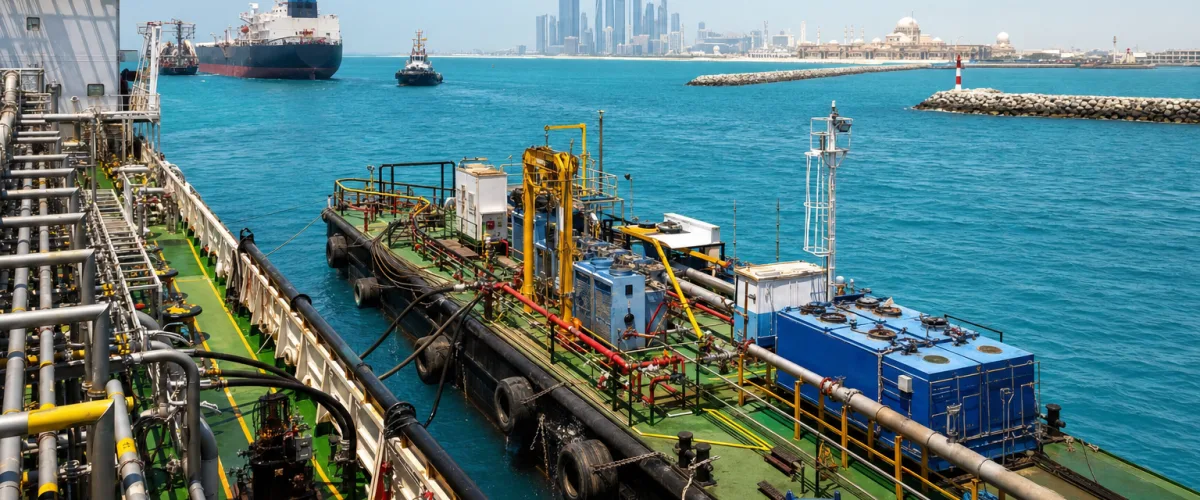
On July 1, 2026, only five vessels transited the Strait of Hormuz, against a pre crisis daily average above 100. Two weeks into a 60 day ceasefire between the United States and Iran, war risk insurance for tankers still runs at roughly eight times pre crisis levels, the central transit corridor remains mined, and Lloyd's Joint War Committee has not lifted its high risk area listing. A thousand kilometers to the west, the Houthis announced on June 8, 2026 a complete ban on Israeli linked shipping in the Red Sea, then paused after a June 14 memorandum consolidated the Iran ceasefire, leaving Bab el Mandeb quiet for now but not resolved. Compliance teams covering the Gulf and the Red Sea are not managing a single regulatory calendar in 2026, they are managing two active security corridors on top of it.
Underneath that instability sits a functioning regulatory architecture. Saudi Arabia's Mawani, the UAE's Ministry of Energy and Infrastructure, Qatar's Ministry of Transport, and Israel's Administration of Shipping and Ports all enforce the same IMO conventions, SOLAS, MARPOL, STCW, through national circulars and a shared Gulf Cooperation Council Port State Control regime, the Riyadh Memorandum of Understanding. A vessel calling at Jeddah, Fujairah, and Hamad Port on the same voyage answers to three separate national implementations of MARPOL Annex VI, one shared PSC inspection database, and, if it touches Europe on the same rotation, the EU ETS and FuelEU Maritime on top.
Which regulators actually enforce maritime compliance across the Gulf and Red Sea?
Six national maritime authorities carry the enforcement weight, coordinated through one shared inspection regime. Saudi Arabia's Mawani (the Saudi Ports Authority) enforces MARPOL and SOLAS in Saudi waters through its own compliance circulars. The UAE's Ministry of Energy and Infrastructure, which absorbed the former Federal Transport Authority in 2020, regulates registration, licensing, and IMO implementation nationally, while each emirate runs its own port level enforcement. Qatar's Ministry of Transport, through its Maritime Transport Affairs Department, handles ship registration and IMO compliance, and automated 14 additional vessel and seafarer e-services in May 2026. Israel's Administration of Shipping and Ports enforces ISPS compliance so strictly that a foreign vessel without a valid certificate is refused entry outright. All six GCC states also inspect under the Riyadh MoU, a Port State Control framework established in 2004 that recorded 36 detentions across 3,649 inspections in the most recent full reporting year, with a tanker and cargo operations campaign scheduled for the fourth quarter of 2026.
Is the Strait of Hormuz safe to transit again in mid-2026?
Not yet, and the insurance market is pricing that directly. The Strait, which carries roughly 20 percent of global seaborne oil trade, saw daily transits collapse from a pre crisis range of 100 to 140 vessels down to 2 to 4 vessels a day at the height of the conflict that began February 28, 2026, with more than 2,000 vessels and 20,000 seafarers stranded at chokepoints. Hull war risk premiums peaked near 5 percent of vessel value before easing to roughly 2 percent after the ceasefire, still eight times the pre crisis baseline as of early July 2026. Clean product tankers face steeper war premiums, 7 to 9 percent of hull value, than crude carriers at 5 to 5.75 percent, since thinner freight margins on smaller tankers absorb the surcharge less easily. The Joint War Committee has said its high risk designation will not lift until there is sustained incident free passage, a settled political picture, and confirmed demining, a bar the market does not expect to clear quickly even if the ceasefire holds past its 60 day window.
What does the Houthi Red Sea ban on Israeli-linked vessels mean for compliance teams?
It means flag, ownership, and port call history now function as a compliance filter, not just a commercial one. After the Houthis fired missiles at Israel on June 8, 2026 during the Israel-Iran war, their military spokesman announced a total ban on Israeli maritime navigation in the Red Sea, declaring any related vessel movement a military target. The ban and further attacks paused after the June 14 memorandum consolidating the US-Iran ceasefire, and as of early July 2026 the IMO has reported no new incidents to the UN Security Council. But the underlying targeting logic from the 2023 to 2025 campaign has not changed: vessels with an Israeli, US, or UK association, or belonging to a fleet whose parent company calls at Israeli ports, remain flagged as high risk by advisories such as MARAD's, whether or not attacks are currently active. The Suez Canal has absorbed the financial damage of that campaign directly. Canal revenue fell from a record 10.25 billion dollars in 2023 to 3.991 billion dollars in 2024, a 61.1 percent drop, while annual vessel transits fell from 26,434 to 13,213 over the same period, and 2025 transits slipped further to 12,758. Egypt's president put the cumulative loss since the crisis began at approximately 10 billion dollars as of May 2026.
How strict is Saudi Arabia's bunker fuel and scrubber enforcement at its ports?
Strict enough that Mawani has gone further than the IMO baseline on one specific point. Mawani's Circular No. 21 of 2019 mandated compliance with MARPOL Annex VI Regulation 14 from January 1, 2020, requiring all ships, Saudi flagged or not, to burn fuel oil with sulphur content no higher than 0.50 percent mass by mass in Kingdom waters, with exhaust gas cleaning systems accepted as an alternative. Mawani then issued Circular No. 55 of 2020, based on guidance from the General Authority of Meteorology and Environmental Protection, effectively preventing ships from discharging open loop scrubber wash water into Saudi ports and territorial waters, a stricter position than jurisdictions that still allow open loop discharge outside designated zones. Enforcement runs through the Riyadh MoU Port State Control system, which can detain a vessel, and through the Commercial Maritime Law of 2019 (Royal Decree No. M/33), which imposes strict liability for pollution and wreck removal alongside a compulsory insurance requirement.
What changed when the UAE replaced its 1981 Maritime Code?
Federal Decree-Law No. 43 of 2023 replaced legislation unrevised since 1981, and it does more than modernize definitions. The law applies to all seagoing vessels operating consistently with the international agreements the UAE has ratified, and puts an explicit duty on the Ministry of Energy and Infrastructure and each emirate's competent authority to ensure national ships meet IMO requirements and to inspect foreign ships in UAE waters for compliance. The UAE has acceded to 35 IMO treaty instruments, a record that put it on comparable footing with developed maritime nations in the IMO's 2016 member state audit. That legal modernization sits alongside a more immediate operational problem: Fujairah, the world's third largest bunkering hub and the source of roughly 60 percent of its bunker volume as VLSFO, saw supply tighten sharply through 2026, first after a March fire and again amid the Hormuz conflict, with VLSFO trading at a premium of 214 dollars per metric ton over Singapore and Zhoushan quotes during the worst of the crunch. UAE waters are not a designated Emission Control Area, but the 0.50 percent global sulphur cap still applies, and Bunker Delivery Notes and retained fuel samples remain the documents UAE port inspectors check first.
Why are Qatar's LNG carriers facing new SOLAS equipment mandates in 2026?
Because Qatar is scaling its LNG fleet faster than almost any other operator, and the IMO's newest safety amendments landed squarely on that fleet type. From January 1, 2026, all newbuild LNG carriers of 3,000 gross tonnage and above must carry electronic inclinometers, a SOLAS requirement giving crews more precise real time stability data during terminal approaches. QatarEnergy is expanding its LNG carrier fleet toward 200 vessels within five years, anchored by Hamad Port and the Ras Laffan and Mesaieed industrial clusters, meaning a large share of near term newbuild orders falls directly under the new mandate. Qatar's domestic legal framework layers on top of SOLAS and MARPOL: Decree Law No. 29 of 1966 governs port operator and vessel liability for loading and unloading incidents, Law No. 15 of 1980 covers liability for collisions and salvage, and Decree Law No. 30 of 2002 sets the environmental baseline the Ministry of Transport enforces alongside MARPOL. The Ministry has also automated 14 additional e-services in May 2026 covering vessel registration and GMDSS operator endorsements under SOLAS.
| Date | What changes | Regulator or body |
|---|---|---|
| January 1, 2026 | Electronic inclinometers mandatory on newbuild LNG carriers 3,000 GT and above | IMO / SOLAS |
| February 28, 2026 | Israel-Iran war begins, Strait of Hormuz transits collapse | N/A |
| June 8, 2026 | Houthis announce total ban on Israeli-linked Red Sea shipping | Houthi movement |
| Mid-June 2026 | 60 day US-Iran ceasefire begins, Hormuz war risk premiums start easing | Lloyd's Joint War Committee |
| June 14, 2026 | Memorandum consolidates ceasefire, Houthi Red Sea attacks pause | N/A |
| Q4 2026 | Riyadh MoU concentrated inspection campaign on tankers, Annex I, cargo operations | Riyadh MoU (GCC) |
What should compliance and regulatory affairs teams track through the rest of 2026?
Track the 60 day ceasefire clock in the Strait of Hormuz as a live variable, not a settled fact, since insurers have said premiums will not fall further without a sustained, multi year run of incident free transits. Confirm which vessels in a fleet trading through the Red Sea carry an Israeli, US, or UK association, since that drives Houthi targeting risk independent of whether attacks are currently active. Verify Bunker Delivery Note and fuel sampling procedures ahead of any Fujairah or Jeddah call, given how quickly Gulf bunker supply has tightened twice already in 2026. And if a Qatari LNG newbuild is in the order book, confirm the electronic inclinometer requirement is specified before steel is cut, not retrofitted after delivery.
None of these sources sit in one register. The Riyadh MoU publishes detention data separately from Mawani's own circulars, the UAE's Federal Decree-Law sits apart from Qatar's Ministry of Transport e-services, and Houthi targeting advisories come from flag state and naval sources that rarely reach a standard regulatory feed. Obsidian tracks each of these Gulf and Red Sea sources at the jurisdiction level, from Mawani and the UAE Ministry of Energy and Infrastructure to Qatar's Ministry of Transport and Israel's Administration of Shipping and Ports, and surfaces the changes that touch a given fleet through per-jurisdiction monitoring and alerts rather than a generic maritime news feed. Teams already running AI tooling internally can query the same verified data through the MCP, while the AI companion answers direct questions, such as when a specific Mawani circular took effect, without a search through PDFs in three languages. Start with the corridor that carries your own fleet's exposure, then build the monitoring habit before the next ceasefire clock starts ticking.