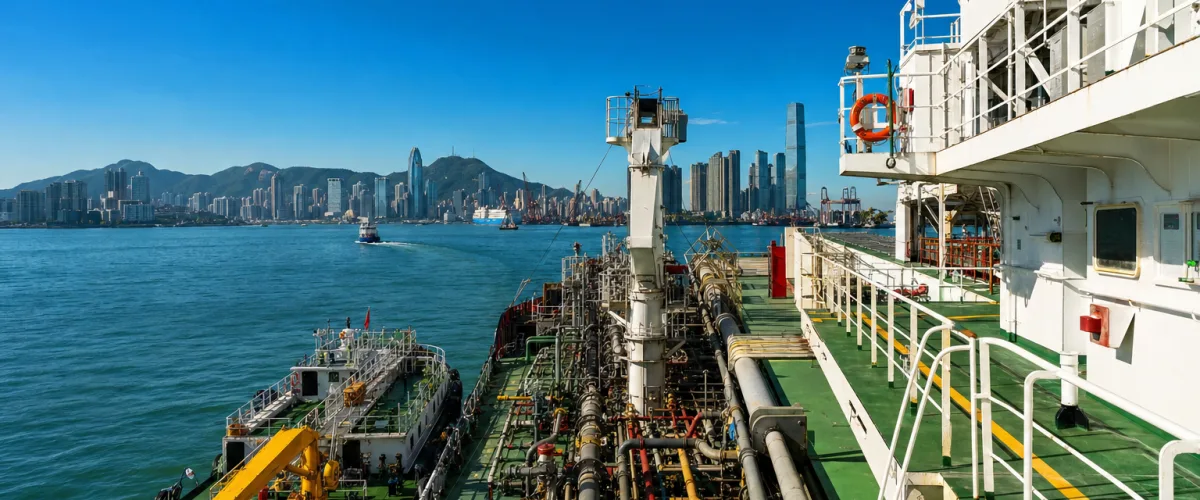
On January 1, 2026, every ship trading into Asia-Pacific ports woke up to a stricter Carbon Intensity Indicator. Resolution MEPC.400(83), adopted at MEPC 83 in April 2025, locked in an 11% reduction factor against the 2019 reference line for 2026 and 13.625% for 2027, closing the placeholder that had sat in the CII framework since 2021. Eleven months later, on December 4, 2026, the IMO's Marine Environment Protection Committee resumes its second extraordinary session to decide, again, whether the Net-Zero Framework, shipping's first global carbon price, gets adopted at all.
Nowhere does that uncertainty land harder than in Asia-Pacific. China, Japan, Singapore, and South Korea between them flag, own, or build most of the world's merchant fleet, yet the region is also where the rulebook fragments the most: China has not ratified the Hong Kong Convention on ship recycling even though it is one of the world's five largest recycling nations, India passed an entirely new Merchant Shipping Act in 2025 to replace a 1958 law with 561 sections, and the Tokyo Memorandum of Understanding rewrote its flag and company performance categories in the middle of 2025.
None of this is theoretical for a compliance team. It is the operating environment for the rest of 2026: a CII target that just got harder to hit, a port state control regime that changed its own vocabulary, and a global carbon-pricing vote whose outcome nobody in the region can safely assume.
Which regulators actually drive maritime enforcement across Asia-Pacific?
The IMO sets the floor through SOLAS, MARPOL, and the CII framework in MARPOL Annex VI, but enforcement in the region runs through a dense layer of national maritime administrations that do not always move in step. China's Ministry of Transport and its Maritime Safety Administration operate a domestic emission control area regime that is legally separate from any IMO-designated ECA. Japan's Ministry of Land, Infrastructure, Transport and Tourism and the Japan Coast Guard enforce SOLAS and MARPOL directly, while Singapore's Maritime and Port Authority runs one of the busiest port state control operations in the world alongside its own green shipping incentive scheme. Australia's AMSA and India's Directorate General of Shipping round out the five administrations that between them inspect the majority of the region's port calls.
The Tokyo Memorandum of Understanding coordinates port state control targeting across all of these authorities, but it does not replace them: each flag and port administration still applies its own domestic instrument. A compliance team tracking only the IMO convention text misses the domestic ECA rule that determines fuel switching off the Chinese coast, and the one tracking only a single flag administration misses the regional PSC targeting that decides which ships get boarded next. Obsidian's regulatory monitoring is built around that layered structure, following the IMO instrument, each national implementing rule, and the Tokyo MOU targeting criteria as one connected thread rather than five unrelated alerts.
How much tighter did the Carbon Intensity Indicator just get?
MEPC.338(76) set the CII reduction factor at 5% for 2023, rising to 9% by 2025, but the factors for 2027 through 2030 were left as placeholders when the guidelines were first adopted in 2021. MEPC.400(83), adopted on April 11, 2025, filled in the missing years: 11% for 2026, 13.625% for 2027, 16.25% for 2028, 18.875% for 2029, and 21.5% for 2030, an increment of 2.625 percentage points every year from 2027 onward. Because the reference line falls with a ship's own deadweight or gross tonnage, the required CII is specific to each vessel, but every ship in the region now faces a materially harder target than it did in 2025.
A ship that slips to a D rating for three consecutive years, or an E rating in any single year, must submit a corrective SEEMP Part III action plan for approval before continuing to trade, and increasingly a class society or charterer wants to see that plan before fixing the ship at all. With the reference factors now locked through 2030, fleet planning has a fixed target to build against, but it also removes any argument that the 2027 step change was still uncertain.
Will the IMO Net-Zero Framework actually be adopted on December 4, 2026?
The Net-Zero Framework, the IMO's proposed global fuel intensity standard and carbon pricing mechanism, was approved at MEPC 83 in April 2025, but a formal adoption vote scheduled for the extraordinary session in October 2025 adjourned without agreement after a roll-call vote exposed insufficient consensus, led by opposition from the United States and Saudi Arabia. MEPC 84 concluded on May 1, 2026 with most delegations reaffirming the framework as the basis for further work, and the Committee set two intersessional working groups, September 1 to 4 and November 23 to 27, 2026, feeding into MEPC 85 from November 30 to December 3, immediately before the resumed extraordinary session on December 4.
Even industry analysts who track the process closely describe adoption on December 4 as unlikely given how entrenched the positions remain, which would push the framework's earliest realistic entry into force well past the originally planned March 2027 date and deep into 2028 or later. For operators trading through Asia-Pacific ports, that means 2026 closes with no enforceable global carbon price, only a set of regional and domestic measures, China's ECA rules, Singapore's green incentives, that apply unevenly across the same trade lanes.
| Track | Status in 2026 | Who it affects |
|---|---|---|
| IMO CII reduction factors | Locked through 2030 by MEPC.400(83); 11% cut for 2026 | Every ship subject to MARPOL Annex VI regulation 28 |
| IMO Net-Zero Framework | Adoption vote resumes December 4, 2026; outcome uncertain | All ships, pending a global carbon price decision |
| Hong Kong Convention (ship recycling) | In force since June 26, 2025; China not a Party | Ships flagged in or recycled through India, Japan, Marshall Islands |
| Tokyo MOU performance lists | Renamed Low/Medium/High from Black/Grey/White, effective July 1, 2025 | All flags and companies inspected under the Tokyo MOU |
| China coastal DECA sulphur cap | 0.50% m/m remains in force; 0.1% tightening still unconfirmed | Ships transiting Chinese coastal emission control areas |
| India Merchant Shipping Act, 2025 | Assented August 18, 2025; awaiting commencement notification | Ships registered in or trading with India |
Why does ship recycling still split the region's biggest players?
The Hong Kong Convention on the safe and environmentally sound recycling of ships entered into force globally on June 26, 2025, requiring an Inventory of Hazardous Materials on every ship above 500 gross tonnage and mandating recycling only at authorized facilities. Japan, India, and the Marshall Islands are all Parties, and the Marshall Islands registry, the world's third largest by gross tonnage, has applied the convention to its fleet since entry into force. China, however, has not ratified it, despite being one of the five countries, alongside Bangladesh, India, Pakistan, and Turkiye, that carry out almost all global ship recycling by tonnage.
That absence matters because a ship built, owned, or recycled through Chinese facilities sits outside the convention's authorization regime even as its Marshall Islands or Japanese-flagged counterparts must comply fully. Reports out of Hong Kong suggest the mainland government and the Hong Kong Special Administrative Region are both considering ratification, but neither has acted as of mid-2026. Reconciling a fleet's Hong Kong Convention status against its Inventory of Hazardous Materials, its flag state's ratification record, and its next scheduled port state control inspection across multiple jurisdictions at once is exactly the kind of cross-referenced question Obsidian's AI answers directly, sourced back to the convention text and each flag's accession record rather than a summary that goes stale the next time a country ratifies.
What changed on the ground in India, China, and Singapore this year?
India replaced its Merchant Shipping Act, 1958, 561 sections built up over 67 years, with the Merchant Shipping Act, 2025, which received presidential assent on August 18, 2025. The new law condenses the framework into 325 clauses across 16 parts, requires registration of all seagoing vessels regardless of size, and aligns India's domestic law more closely with SOLAS, MARPOL, and MLC 2006. As of mid-2026 the Act has not yet been brought into force; that happens only once the central government issues a commencement notification, and different provisions can commence on different dates.
China's coastal emission control areas have applied a 0.50% m/m sulphur cap since January 1, 2019, with a stricter 0.1% limit already in force for inland river ECAs and Hainan's coastal waters. The 2018 implementation scheme committed to studying a coastal-wide tightening to 0.1% from January 1, 2025, but China's Maritime Safety Administration confirmed, as late as December 2025, that no final decision had been made, leaving operators calling at mainland Chinese ports to check current guidance before every voyage. Singapore moved in the opposite direction toward faster liberalization: a Port Marine Circular effective March 7, 2025 raised the ceiling for biofuel blends that licensed bunker tankers can carry and deliver without separate MPA approval from B25 to B30, part of a Maritime Singapore Green Initiative that has committed another 50 million Singapore dollars in incentives running through December 31, 2027.
What should a compliance team in the region prioritize right now?
Start with the CII: confirm which of your ships already sit at D or E rating under the locked-in 2026 factor, because a corrective action plan submitted late is the fastest way to lose a charter. Then separate your Hong Kong Convention exposure by flag rather than by fleet-wide assumption, since a Marshall Islands or Japanese-flagged ship carries obligations a Chinese-flagged or Chinese-recycled one currently does not. Finally, treat the December 4 Net-Zero Framework session as a date to monitor, not a deadline to plan capital spending against, given how far consensus still has to travel.
Obsidian tracks the IMO, China's MSA, Japan's MLIT, Singapore's MPA, India's DGS, and AMSA behind each of these regimes at the framework level, with alerts when a Z factor is confirmed, a convention gains or loses a Party, or a domestic sulphur rule finally moves off placeholder status. See the plans built for maritime regulatory-affairs and compliance teams operating across Asia-Pacific, or connect Obsidian's MCP directly into your own tools if your workflow already runs through an AI assistant.