

The European Securities and Markets Authority (ESMA) will begin accepting notifications from ESG rating providers on August 2, 2026. This is the first mandatory registration deadline under Regulation (EU) 2024/3005, which makes ESG rating activities a regulated financial service in the European Union for the first time. This article covers who is affected, what the notification process requires, and what happens to providers that miss the deadline.
What is Regulation (EU) 2024/3005?
Regulation (EU) 2024/3005, formally titled "Regulation on the transparency and integrity of Environmental, Social and Governance (ESG) rating activities," was adopted by the European Parliament and Council on November 27, 2024. It was published in the Official Journal of the European Union on December 11, 2024, and entered into force on December 17, 2024.
The regulation establishes binding rules for ESG rating providers operating in the EU. It requires them to register with ESMA, disclose their methodologies, manage conflicts of interest, and meet governance standards. ESMA becomes the direct supervisor of all authorized ESG rating providers, similar to its role overseeing credit rating agencies under the CRA Regulation.
When does the ESG Rating Regulation apply?
The regulation's date of application is July 2, 2026. From this date, the rules become enforceable. ESG rating providers that were already operating in the EU at the time of entry into force (December 17, 2024) enter a transitional regime that allows them to continue operating while seeking authorization.
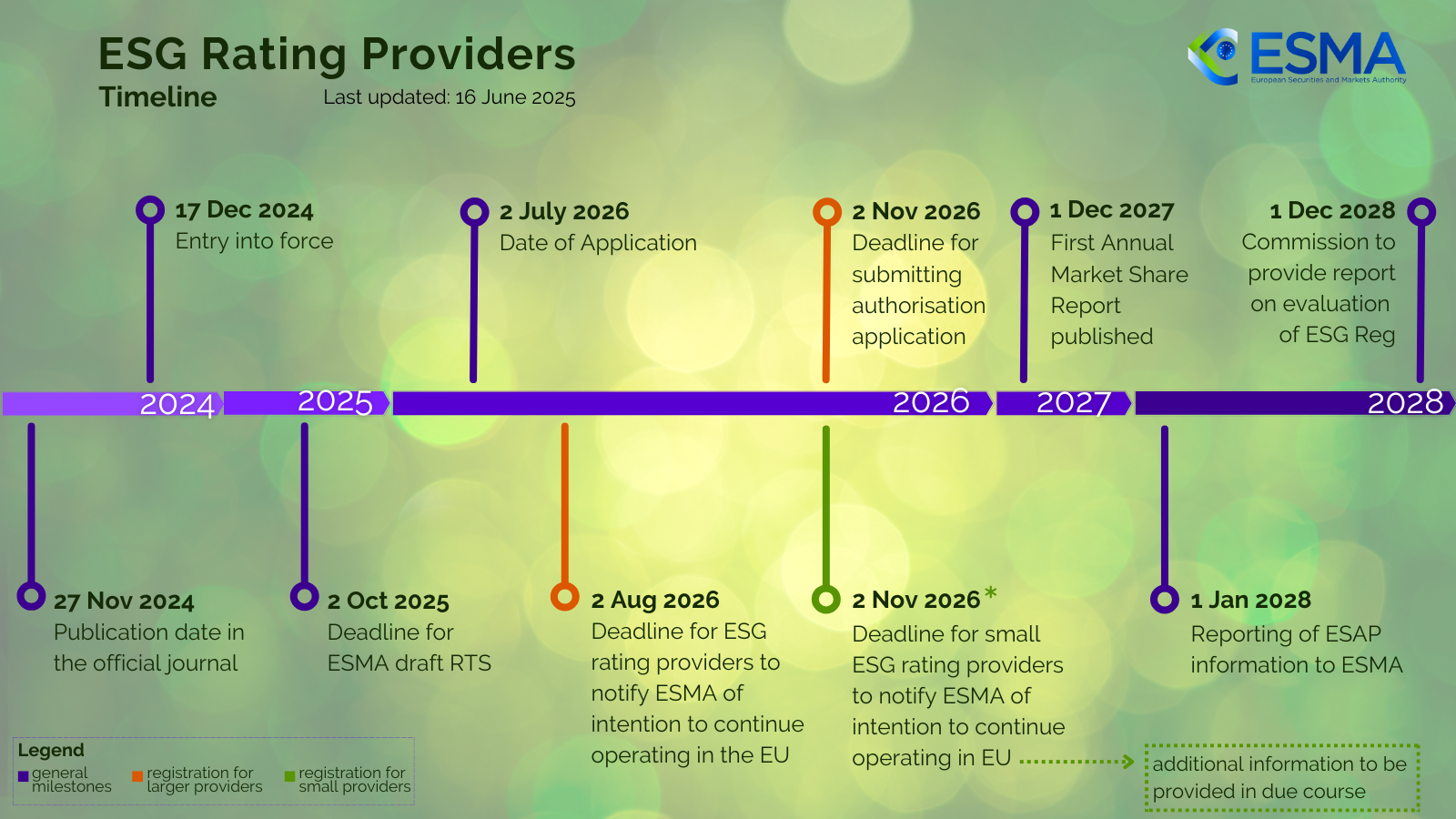
The full timeline of key dates is:
| Date | Event |
|---|---|
| 27 Nov 2024 | Publication in the Official Journal |
| 17 Dec 2024 | Entry into force |
| 2 Oct 2025 | Deadline for ESMA draft regulatory technical standards (RTS) |
| 2 Jul 2026 | Date of Application: regulation becomes enforceable |
| 2 Aug 2026 | Notification deadline for existing ESG rating providers |
| 2 Nov 2026 | Deadline for submitting full authorization applications |
| 2 Nov 2026 | Notification deadline for small ESG rating providers |
| 1 Dec 2027 | First Annual Market Share Report published |
| 1 Jan 2028 | Reporting of ESAP information to ESMA begins |
| 1 Dec 2028 | Commission report on evaluation of ESG Rating Regulation |
Who needs to register with ESMA for ESG ratings?
The regulation applies to any entity that issues, publishes, or distributes ESG ratings on a professional basis within the EU. This includes:
- Global ESG rating agencies (such as Morningstar/Sustainalytics, MSCI, ISS, S&P Global, and Bloomberg) that provide ratings used by EU-based investors
- Boutique and specialized ESG research firms operating in the EU
- Third-country ESG rating providers whose ratings are used or distributed within the EU (through equivalence, recognition, or endorsement pathways)
ESMA has published a self-assessment tool to help entities determine whether their activities fall within the scope of the regulation. Entities that provide ESG data without issuing overall ESG scores or ratings may fall outside scope, though the boundaries require careful analysis.
What is the August 2, 2026 notification deadline?
ESG rating providers that were operating in the EU when the regulation entered into force (December 17, 2024) must notify ESMA of their intention to continue operating by August 2, 2026. This is one month after the regulation's date of application (July 2, 2026).
The notification is the first step in the authorization process. After notifying ESMA, providers are temporarily listed in the register and may continue operating while their full authorization application is reviewed. Providers then have until November 2, 2026 to submit a complete authorization application.
Small ESG rating providers, as defined in Article 5(1) of the regulation, have an extended notification deadline of November 2, 2026.
What happens if an ESG rating provider does not notify ESMA?
Providers that fail to notify ESMA by the deadline will not be included in the temporary register. Without registration, they cannot legally offer ESG rating services in the EU after July 2, 2026. This effectively means losing access to the European market until a full authorization is obtained.
For users of ESG ratings (asset managers, pension funds, insurers), this means verifying that the providers they rely on have notified ESMA and are either authorized or in the process of authorization. Using ratings from non-registered providers could create regulatory and legal risk.
What is the difference between authorization, recognition, and endorsement?
The regulation provides three pathways for ESG rating providers to operate in the EU:
- Authorization: For EU-based providers. Requires full compliance with governance, transparency, and conflict of interest rules. ESMA grants authorization after reviewing the complete application.
- Recognition: For third-country providers that do not have a group connection to an EU entity. The provider must appoint an EU legal representative and meet specific conditions.
- Endorsement: For third-country providers whose ratings are endorsed by an EU-authorized affiliate. The EU entity takes responsibility for the endorsed ratings.
What must ESG rating providers disclose under the regulation?
The regulation imposes transparency requirements that go significantly beyond current market practice:
- Methodology transparency: Providers must publish detailed descriptions of their rating methodologies, including models, key assumptions, data sources, and the scope of each ESG factor (Environmental, Social, Governance)
- Separation of E, S, and G: Where a provider issues an overall ESG rating, it must also disclose the individual weightings for Environmental, Social, and Governance components
- Data source disclosure: Providers must indicate whether their ratings are based on company-reported data, estimated data, or third-party data
- Conflict of interest management: Structural separation between ESG rating activities and consulting or advisory services to the same rated entities
- Governance requirements: Management body composition, compliance function, and internal control standards
How does this affect investors using ESG ratings?
The regulation also amends Article 13 of the Sustainable Finance Disclosure Regulation (SFDR). Financial market participants that use ESG ratings in their marketing materials must now display specific details about the rating provider, including whether the provider is authorized by ESMA.
For asset managers and institutional investors, the practical impact includes:
- Due diligence obligations to verify ESG rating provider authorization status
- Documentation requirements when using ESG ratings in investment decision processes
- Marketing material updates to include provider disclosure as required by the SFDR amendment
- Governance adjustments to internal processes for selecting and monitoring ESG data providers
What is the broader regulatory context?
The ESG Rating Regulation is part of a broader wave of EU sustainability regulations converging in 2026. It sits alongside:
- CSRD (Corporate Sustainability Reporting Directive): Requires companies to report sustainability data using ESRS standards, which ESG rating providers then consume
- CSDDD (Corporate Sustainability Due Diligence Directive): National transposition deadline of July 26, 2026, just four days before the ESG Rating Regulation applies
- SFDR 2.0: Proposed revision introducing new product categories (Sustainable, Transition, ESG Basics) that will change how ESG ratings are used in fund marketing
- EU Taxonomy: Amended delegated acts applicable from January 2027, changing which activities qualify as environmentally sustainable
These frameworks are deeply interconnected. ESG ratings consume CSRD data, feed into SFDR disclosures, and reference Taxonomy criteria. Changes in one framework ripple across all others.
How can organizations track ESG regulatory changes?
The volume and pace of EU ESG regulatory changes in 2026 make manual monitoring impractical. Compliance teams need to track publications from ESMA, the European Commission, EFRAG, national transposition bodies, and multiple other EU institutions simultaneously.
Regulatory intelligence platforms that specialize in ESG and sustainable finance frameworks provide real-time monitoring of these official sources. Obsidian's ESG Regulatory Intelligence Dashboard tracks CSRD, CSDDD, EU Taxonomy, EU ETS, and CBAM from official EU institutions, delivering updates as they are published.
For organizations exposed to the ESG Rating Regulation specifically, the key sources to monitor include:
- ESMA publications on ESG rating provider supervision
- EU Official Journal for delegated and implementing acts
- European Commission sustainable finance publications
- National financial regulators for member state implementation


