
For more than a decade, ESG ratings operated as unregulated market opinions. Rating agencies published scores, investors consumed them, and the companies being rated had limited recourse or visibility into how their profile was constructed. That era ends on July 2, 2026, when Regulation (EU) 2024/3005 becomes enforceable across the European Union.
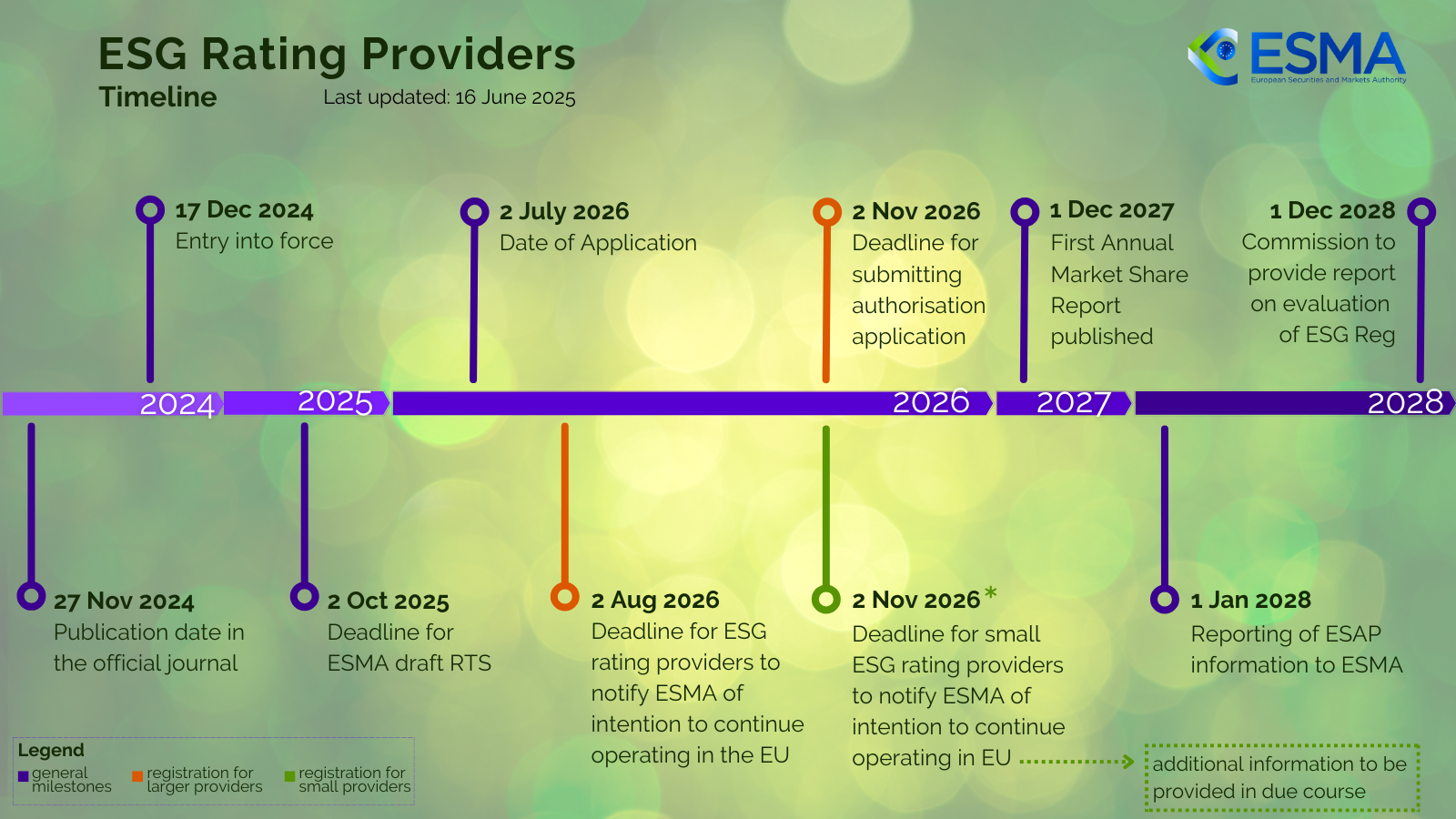
The headline deadline is August 2, 2026, when existing ESG rating providers must notify ESMA of their intention to continue operating in the EU. But the real story is not the deadline itself. It is what this regulation reveals about where EU sustainable finance policy is heading, and what compliance teams, asset managers, and rating consumers should be doing right now.
Why ESG ratings needed regulation
The parallels with credit rating agencies are instructive. Before the 2008 financial crisis, credit rating agencies operated with minimal oversight. Their ratings carried enormous market influence, yet the methodologies behind them were opaque, conflicts of interest were pervasive, and accountability was effectively nonexistent. The CRA Regulation (EC No 1060/2009) changed that by establishing ESMA oversight, transparency requirements, and governance standards.
ESG ratings in 2024 occupied a remarkably similar position. A study commissioned by the European Commission found significant divergence between ESG ratings issued by different providers for the same company, sometimes contradicting each other entirely. An entity rated "best in class" by one agency could be rated "below average" by another. The reasons were structural: different methodologies, different data sources, different weighting of E, S, and G factors, and different scopes of analysis.
For investors relying on these ratings to meet SFDR disclosure requirements or to market "sustainable" funds, this divergence created real legal and reputational risk. The regulation addresses this not by harmonizing methodologies (providers remain free to use their own approaches) but by requiring transparency about how ratings are produced and ensuring structural safeguards against conflicts of interest.
What changes on August 2, 2026
The regulation's application date is July 2, 2026. One month later, on August 2, the notification window opens. Every ESG rating provider that was operating in the EU at the time of entry into force (December 17, 2024) must notify ESMA of its intention to continue. After notification, providers are temporarily listed in ESMA's register and may keep operating while their full authorization application is reviewed.
The full authorization application is due by November 2, 2026, four months after the application date. Small providers, defined in Article 5(1), have until November 2 just to notify (not to apply).
This means the market will see a rapid sorting between August and November 2026. Providers that notify will appear in ESMA's temporary register, giving visibility to data consumers. Those that do not will effectively exit the EU market, at least until they complete the full authorization process.
The SFDR connection that most people are missing
Regulation 2024/3005 does not only affect ESG rating providers. It amends Article 13 of the Sustainable Finance Disclosure Regulation (SFDR), adding new requirements for financial market participants that use ESG ratings in their marketing communications.
Specifically, if a fund or financial product references ESG ratings in its marketing materials, the financial market participant must disclose details about the rating provider on its website. This includes whether the provider is authorized by ESMA, which creates a direct commercial incentive for rating providers to complete registration quickly, and for fund managers to verify the authorization status of the agencies they cite.
With SFDR 2.0 on the horizon (proposed November 2025, introducing new product categories of Sustainable, Transition, and ESG Basics), the interplay between rated ESG quality and fund classification is set to intensify. Fund managers making strategic decisions about product categorization under SFDR 2.0 need clarity on which ESG data sources will meet the new regulatory standard. That clarity starts with ESMA authorization.
The conflict of interest problem the regulation is designed to solve
One of the regulation's most significant provisions is the requirement for structural separation between ESG rating activities and consulting or advisory services provided to the same rated entities. This directly addresses a well-documented concern: ESG rating providers that also sell advisory services to the companies they rate face inherent conflicts of interest.
The regulation requires providers to implement organizational safeguards, including independent compliance functions, management body oversight, and documented procedures for identifying and managing conflicts. For providers that have built diversified business models combining ratings, consulting, and data services, this may require significant restructuring.
For rating consumers, this is arguably the most impactful provision. It means that over time, ESG ratings from authorized providers will carry a higher degree of structural independence, making them more reliable as inputs to investment decisions and regulatory disclosures.
The market will split, and compliance teams must adapt
Not every current ESG rating provider will seek EU authorization. Some smaller or specialized firms may conclude that the cost of compliance outweighs the benefit of EU market access. Others may restructure, merging rating operations with larger authorized entities or transitioning to data-only models that fall outside the regulation's scope.
For compliance teams at financial institutions, this means updating internal procedures:
- Vendor due diligence: Verify that each ESG rating provider you use has notified ESMA and is in the authorization pipeline. This should be checked against ESMA's temporary register once it becomes available.
- Marketing material review: Audit all fund marketing materials that reference ESG ratings. Ensure compliance with the amended SFDR Article 13 disclosure requirements.
- Data governance: Document the ESG rating providers used in investment processes, the methodologies they follow, and any material differences between providers. This documentation will be increasingly important as ESMA supervision matures.
- Forward planning for SFDR 2.0: If your fund classification strategy under SFDR 2.0 depends on ESG ratings, confirm that the ratings come from providers that will be authorized. An unauthorized provider's rating cannot safely be used in regulatory disclosures.
The 2026 convergence: this deadline does not exist in isolation
The ESG Rating Regulation applies on July 2, 2026. The CSDDD national transposition deadline is July 26, 2026. The simplified ESRS standards under the CSRD Omnibus are expected by summer 2026. The EU Taxonomy amended delegated acts take effect January 1, 2027. SFDR 2.0 is progressing through legislative process.
These are not separate regulatory events. They are interconnected components of a single policy architecture. ESG rating providers will consume CSRD-reported data, which follows ESRS standards, which reference Taxonomy criteria. The ratings they produce will be used in SFDR disclosures, which must comply with SFDR 2.0 categories. CSDDD due diligence findings will affect both company ESG profiles and the data available to rating providers.
Tracking any one of these frameworks in isolation gives an incomplete picture. The organizations that navigate 2026 successfully will be those that monitor all EU ESG frameworks simultaneously, understanding both the individual obligations and the dependencies between them.
What Obsidian provides for ESG regulatory intelligence
The Obsidian ESG Regulatory Intelligence Dashboard was built specifically for this challenge. It provides real-time monitoring of EU sustainability frameworks from official sources, covering CSRD, CSDDD, EU Taxonomy, EU ETS, and CBAM in a single environment.
The platform tracks publications from ESMA, the European Commission, EFRAG, EU Official Journal, and national regulators across member states. Updates are delivered as they are published, not on a weekly summary basis. Every alert links directly to the original source document, so compliance teams can verify and act on regulatory changes without relying on secondary interpretation.
For teams managing ESG regulatory exposure across multiple frameworks, the dashboard eliminates the fragmented monitoring that creates blind spots. When a Taxonomy delegated act changes screening criteria, or ESMA publishes new guidance on ESG rating provider applications, or a member state transposes CSDDD with additional national requirements, the platform captures it in real time.
Request access to the ESG Regulatory Intelligence Dashboard to see how real-time monitoring of EU sustainability frameworks works in practice.